

The solution to Canada’s brutal winters and draining Zoom calls isn’t just more light, but the right light, strategically applied.
- High-CRI light biologically combats the “winter blues” by mimicking natural sunlight and makes you look more professional and trustworthy on video calls.
- Tunable, flicker-free light allows you to sync your workspace with your body’s natural circadian rhythm, improving both focus during the day and sleep quality at night.
Recommendation: Treat your desk lamp not as an office expense, but as a crucial, long-term investment in your mental health, productivity, and professional image.
That familiar feeling of dread creeps in around 3 PM on a Tuesday in February. Outside your basement office window, the world is a monochrome grey, and the darkness seems to be leaching the energy and colour from your very being. Your eyes ache from the cheap LED bulb overhead, and you know you look like a ghost on your next video call. You’ve heard about SAD lamps, but the thought of another bulky, single-purpose gadget cluttering your desk feels more depressing than the problem itself.
Most advice stops at “get more light.” But this is a superficial fix for a complex problem. The issue isn’t just the quantity of light; it’s the quality, the timing, and its purpose. The standard approach fails to connect the dots between the light we see, how our bodies feel, and how others perceive us in a professional context. It treats the symptom of winter sadness without addressing the underlying environmental and biological factors.
But what if the true key isn’t just a brute-force blast of brightness, but a sophisticated, holistic approach to what I call “Light Hygiene”? This article will demonstrate that a high-CRI, tunable smart lamp is not a mere gadget. It is a strategic wellness tool that can transform your Canadian basement office from a source of dread into a performance sanctuary. It’s an investment in your biology, your focus, and your digital presence.
We’ll explore how the right light can genuinely lift your mood, why cheap LEDs are sabotaging your health and productivity, and how a quality desk lamp can make you look more competent and trustworthy on every video call. This guide provides a clear roadmap to reclaiming your energy and professional edge during the longest Canadian winters.
Summary: Why a Smart Lamp is a Strategic Winter Investment
- Can Smart Lighting Actually Cure Your “February Blues” in Canada?
- Why your cheap LED bulbs make your home feel like a hospital waiting room?
- Tunable White Light: How changing light warmth throughout the day improves sleep?
- Smart Lighting for Focus: How changing color temperature signals your brain to work?
- Flicker-Free Technology: Why cheap LEDs give you headaches after 4 hours?
- The Ring Light Effect: Can a desk lamp replace professional studio lighting for Zoom?
- Clamp vs. Base: How to light your desk without losing precious surface area?
- Voice Control: Is it useful to control your desk lamp with Alexa?
Can Smart Lighting Actually Cure Your “February Blues” in Canada?
The “winter blues” are a tangible part of the Canadian experience. A comprehensive study on the topic revealed that 60% of Canadians report feeling seasonal mood changes each year. For many, this manifests as Seasonal Affective Disorder (SAD), a condition far more serious than a simple low mood. In fact, research shows that while 15% of Canadians may experience mild SAD, another 2-3% suffer from a more severe, debilitating form. This isn’t just a feeling; it’s a measurable impact on energy, motivation, and overall well-being, particularly for remote workers isolated in inadequately lit spaces.
This is where the concept of Chromatic Wellness comes into play. It’s the practice of using the quality and color of light to positively influence your biological and psychological state. A high-quality smart lamp does more than just illuminate a room; it provides the specific light spectrums your brain craves during the dark winter months. By delivering light that closely mimics the full spectrum of natural sunlight, it helps regulate the neuro-transmitters responsible for mood and energy.
This isn’t about magical cures, but about providing your body with a critical, missing nutrient: light. Traditional office lighting and cheap home bulbs are the equivalent of a nutritional diet of only beige food. A high-CRI smart lamp, however, provides a rich, varied diet of light that can significantly elevate mood, increase energy levels, and make the long Canadian winter feel far more manageable and productive. It’s a proactive strategy for environmental wellness, transforming your workspace from a contributor to the problem into a key part of the solution.
Why your cheap LED bulbs make your home feel like a hospital waiting room?
Have you ever switched on a light and felt the room’s atmosphere instantly become sterile, cold, and unwelcoming? The culprit is likely a low Color Rendering Index (CRI). CRI is a scale from 0 to 100 that measures a light source’s ability to reveal the true colors of objects compared to natural sunlight. Cheap LED bulbs typically have a CRI of around 80, which is where the problems start. They create a distorted, washed-out version of reality, making vibrant reds appear dull and skin tones look sallow and unhealthy.
This is because low-CRI LEDs have an incomplete light spectrum, often lacking the crucial red and deep blue wavelengths found in sunlight. It’s like listening to your favorite song with the bass and treble completely cut out. Professional lighting studies demonstrate that CRI 95+ lamps vs CRI 80 create 40% better color accuracy. This isn’t a subtle difference; it’s the distinction between a space that feels alive and one that feels like a morgue.
Imagine your iconic Hudson’s Bay point blanket, its rich indigo, green, yellow, and red stripes a symbol of Canadian heritage. Under a low-CRI bulb, those colours become muted and lifeless. But under a high-CRI (95+) light, the wool’s texture pops, and the colours sing with their intended vibrancy. This is what high-CRI light does for your entire home.

This principle of accurate colour rendering directly impacts your well-being. When your environment—and your own reflection in the mirror—looks healthy and vibrant, it sends a positive signal to your brain. A high-CRI lamp doesn’t just make your things look better; it makes your world feel more real, warm, and psychologically nourishing, a critical defence against the draining grey of a Canadian winter.
Tunable White Light: How changing light warmth throughout the day improves sleep?
For millennia, the human body has used the changing color of sunlight—from the crisp, blue-white of morning to the warm, amber glow of sunset—to regulate its internal clock, or circadian rhythm. In our modern, indoor lives, especially during Canadian winters with their short days, we’ve replaced this natural cycle with harsh, static artificial light. This constant, unchanging light sends confusing signals to our brains, disrupting a fundamental biological process. As a leading Canadian mental health authority points out, this is a serious issue.
Changes in light may upset a person’s biological clock, which controls sleep-wake patterns and disturb neurotransmitter functions including serotonin and dopamine.
– Centre for Addiction and Mental Health (CAMH), CAMH Seasonal Affective Disorder Guide
This is where the power of Biometric Lighting with a tunable white lamp comes in. It allows you to practice good “Light Hygiene” by manually recreating the sun’s natural cycle indoors. A tunable lamp lets you shift the color temperature of your light throughout the day. You can start your morning with a cool, high-energy 5000K light to suppress melatonin production and signal to your brain “it’s time to be alert.” As the day winds down, you gradually shift to a warm, relaxing 3000K light, mimicking a sunset and telling your body to prepare for rest.
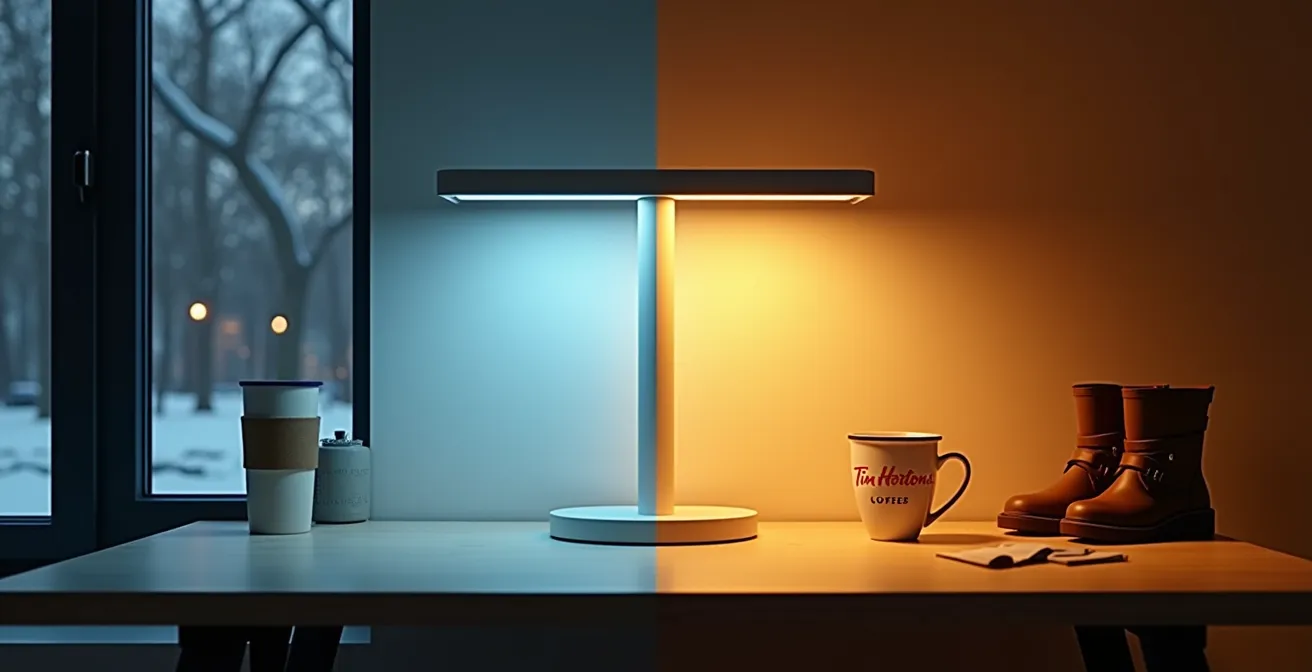
This isn’t just about creating a mood; it’s about working *with* your biology instead of against it. By providing the right light at the right time, you reinforce your natural sleep-wake cycle. This leads to deeper, more restorative sleep at night and higher levels of alertness and focus during the day. For anyone struggling with the fatigue and sleep disturbances that often accompany the winter blues, a tunable white lamp is one of the most powerful tools for reclaiming control over your body’s internal clock.
Smart Lighting for Focus: How changing color temperature signals your brain to work?
Just as warm light signals your brain to relax, cool-toned light acts as a powerful biological cue for concentration and alertness. The blue-white light typical of a bright midday sun (around 5000K-6000K) is scientifically proven to increase focus, improve reaction times, and boost cognitive performance. For a remote worker in a dim basement, trying to power through a complex task at 4 PM as darkness descends, the absence of this specific light spectrum is a significant productivity barrier. Your brain, deprived of its “work” signal, naturally begins to wind down, leading to that all-too-familiar feeling of hitting a “winter wall.”
A smart lamp with tunable color temperature gives you direct control over these biological triggers. You can strategically deploy cool light during periods that require deep focus, effectively creating a zone of high-performance energy on demand. Research into remote work wellness consistently shows the benefits; one forward-looking study found that 46% of employees report higher productivity when their home workspace has a proper, controlled lighting setup. It’s about providing the right signal at the right time.
Instead of succumbing to the afternoon slump, you can flood your desk with a crisp, cool light that tells your brain it’s still peak performance time. This isn’t about forcing yourself to work; it’s about creating an environment that naturally supports your desired mental state. This level of environmental control is a cornerstone of modern productivity, turning your desk into a veritable ‘performance sanctuary’ where you dictate the terms of your focus, not the bleak Canadian winter sky.
Your Action Plan: Canadian Winter Workday Lighting Schedule
- 7:00 AM – Morning Wake-Up: Start your day with a bright 5500K cool white light to suppress melatonin and combat the dark Canadian mornings, simulating a natural dawn.
- 10:00 AM – Peak Focus: Maintain a 5000K daylight temperature for prime working hours to maximize concentration and cognitive function.
- 1:00 PM – Lunch Break Reset: Shift down to a softer 4500K during your lunch break to give your eyes a rest and prevent visual fatigue.
- 3:00 PM – Afternoon Slump Buster: As natural light fades, return to a bright 5000K to counter the ‘winter wall’ and maintain energy for the rest of the workday.
- 5:30 PM – Workday Wind-Down: Begin gradually reducing the color temperature to 4000K to signal to your brain that the workday is ending and it’s time to transition.
Flicker-Free Technology: Why cheap LEDs give you headaches after 4 hours?
The four-hour headache. The inexplicable eye strain. The vague feeling of unease after a long session at your desk. You might blame stress or screen time, but the invisible culprit is often your light source. Most cheap LED bulbs produce high-frequency, imperceptible flicker. While you can’t see it, your brain’s visual cortex and nervous system are working overtime to process the rapid on-off strobing. This constant, subconscious effort leads directly to neurological fatigue, eyestrain, headaches, and even migraines in sensitive individuals.
Investing in a lamp with flicker-free technology is not a luxury; it’s a fundamental health and safety requirement for a modern workspace. These lamps use high-quality drivers and circuitry to provide a stable, continuous stream of light, eliminating the invisible stressor that’s sabotaging your focus and well-being. This is a clear case where the upfront cost is a massive long-term saving. As wellness-focused companies know, creating a healthy work environment has a staggering return on investment. In fact, according to 2024 industry research on corporate wellness, 95% of companies measuring wellness ROI see positive returns.
The “true cost” of a cheap, flickering lamp isn’t its sticker price. It’s the lost productivity, the cost of pain relievers, and the potential for sick days. As the following analysis shows, investing in a quality, flicker-free lamp is one of the smartest financial decisions a remote worker can make.
| Factor | $30 Cheap LED | $150 Flicker-Free Lamp | Annual Impact |
|---|---|---|---|
| Initial Cost | $30 | $150 | $120 difference |
| Productivity Loss (10% for 4hrs/day) | $5,200/year* | $0 | $5,200 saved |
| Headache Medication | $180/year | $0 | $180 saved |
| Sick Days (eye strain) | 3 days ($750) | 0 days | $750 saved |
| True Annual Cost | $6,160 | $150 | $6,010 savings |
This stark comparison reframes the purchase entirely. The $150 lamp isn’t an “expensive” lamp; it’s a high-yield investment that pays for itself in less than a week and delivers over $6,000 in value annually by protecting your most valuable asset: your ability to work comfortably and effectively.
The Ring Light Effect: Can a desk lamp replace professional studio lighting for Zoom?
In the era of remote work, your appearance on a video call is your professional first impression. Many have turned to ring lights, but this is often a mistake. A ring light’s primary function is to create a flat, shadowless light, which can be harsh and create unflattering reflections in your eyes and glasses. More importantly, most consumer-grade ring lights suffer from the same low-CRI issue as cheap bulbs, making skin tones appear unnatural and washed out. They prioritize brightness over quality, a critical error for professional communication.
A high-CRI desk lamp offers a far superior solution for what can be termed your Digital Presence. Research from lighting experts like BenQ demonstrates that high-CRI (95+) lamps significantly improve skin tone accuracy because they contain the full spectrum of light, especially the red wavelengths often missing in cheaper LEDs. This red light is essential for rendering skin in a warm, healthy, and natural way, which is subconsciously interpreted by others as more trustworthy and relatable.

The key is proper positioning. Instead of placing the light in front of you, a high-CRI smart lamp, especially a wide or articulated one, should be positioned above and slightly behind your monitor. This creates a soft, flattering ‘key light’ that models your face, creates gentle shadows for depth, and produces a natural, professional ‘catchlight’ in your eyes. This setup mimics professional portrait lighting, making you look more three-dimensional, engaged, and competent. It’s the difference between looking like a hostage in a poorly lit room and a polished professional in a well-appointed office.
In a virtual meeting, you are not just a voice; you are a visual. A high-CRI desk lamp ensures that visual is a confident, healthy, and professional one, giving you a distinct advantage in every remote interaction.
Clamp vs. Base: How to light your desk without losing precious surface area?
For anyone working from a condo, apartment, or basement office, desk space is a premium, non-renewable resource. A traditional lamp with a large, weighted base can consume 15-20% of your valuable work surface, space that could be used for a second monitor, a notebook, or simply the freedom to spread out. This is a particularly acute problem in major Canadian cities. With Canadian urban living spaces averaging around 600 square feet in Toronto and even less in Vancouver, every square inch counts.
This is where the choice between a clamp mount and a traditional base becomes a strategic decision. A clamp-mounted lamp is a space-saving marvel. It attaches securely to the back or side of your desk, lifting the entire fixture off your work surface and freeing up 100% of that previously occupied real estate. This not only declutters your desk but also offers superior lighting positioning. A clamp allows you to place the light source directly behind your monitor, the ideal spot for perfect video call illumination and even, wide light distribution for tasks, a position that’s often impossible to achieve with a base-style lamp that must sit to the side.
While a lamp with a weighted base offers the flexibility of being easily moved, a clamp mount provides unparalleled stability and optimal positioning for a dedicated workspace. For the modern remote worker in a compact Canadian home, the choice is clear. The small, one-time effort of installing a clamp mount pays daily dividends in the form of a cleaner, larger, and more functional workspace.
| Feature | Clamp Mount | Weighted Base | Best For |
|---|---|---|---|
| Space Saved | 100% desk surface | 15-20% lost | Studios under 500 sq ft |
| Flexibility | Fixed position | Easy to move | Multi-use spaces |
| Stability | Very stable | Can tip if bumped | Households with pets/kids |
| Light Position | Behind monitor ideal | Side lighting only | Video calls |
| Installation | 5 minutes setup | None required | Renters |
| Price Range | $100-200 | $80-180 | Budget conscious |
Key Takeaways
- A high-CRI smart lamp is not an expense, but a strategic investment in your health, productivity, and professional image.
- Controlling light quality (CRI, flicker) and timing (tunable white) allows you to manage your mood, focus, and sleep cycle, directly combating the effects of Canadian winters.
- Superior lighting for video calls is a non-negotiable professional tool, and a high-CRI desk lamp is more effective and flattering than a standard ring light.
Voice Control: Is it useful to control your desk lamp with Alexa?
At first glance, controlling your desk lamp with your voice might seem like a frivolous gimmick. Who needs to ask Alexa to turn on a light that’s within arm’s reach? But for a knowledge worker, the true value of voice control isn’t about saving a few seconds of movement; it’s about preserving one of the most fragile and valuable resources in modern work: the flow state. Every minor physical interruption—reaching for a switch, fiddling with a dial, looking away from your screen to find a button—is a potential “context switch” for your brain. These micro-interruptions shatter concentration and can take several minutes to recover from.
Voice control eliminates this friction entirely. It allows you to adjust your lighting environment without breaking your mental stride or even moving your hands from the keyboard. The ability to simply say “Alexa, brighten my desk lamp” as the afternoon light fades is a powerful tool for maintaining deep focus. This isn’t laziness; it’s a strategic optimization of your cognitive resources, as one Canadian professional’s experience illustrates.
As a software developer in Winnipeg, voice control has been a game-changer for maintaining flow state. When I’m deep in code and realize the room is getting dark at 3:30 PM, I just say ‘Alexa, brighten desk lamp to 80%’ without breaking concentration. It sounds small, but these micro-interruptions add up. On cold Manitoba evenings when I’m bundled up reading, adjusting lights without moving maintains that cozy hygge feeling we all crave during our long winters.
– Canadian Remote Worker Experience
This testimonial perfectly captures the dual benefit. On one hand, voice control is a high-performance productivity tool. On the other, it enhances comfort and well-being, contributing to the feeling of ‘hygge’—a sense of coziness and contentment that is so vital for getting through Canada’s long, cold winters. By removing a source of minor but repeated annoyance, voice control helps transform your workspace into a seamless extension of your thoughts and intentions.
Stop letting winter dictate your mood and career. It’s time to invest in a lighting environment that works for you. Assess the right high-CRI smart lamp for your workspace and transform your Canadian winter experience today.
Frequently Asked Questions about Why your cheap LED bulbs make your home feel like a hospital waiting room?
Why do cheap LEDs make people look sick during winter?
Low CRI LEDs lack red spectrum light, making skin appear pale and unhealthy – especially problematic during Canadian winters when people already have less sun exposure.
How does CRI affect the appearance of my home during gatherings?
High CRI lighting makes food look appetizing, guests appear healthy, and creates the warm, welcoming atmosphere crucial for Canadian hospitality during long winter months.