
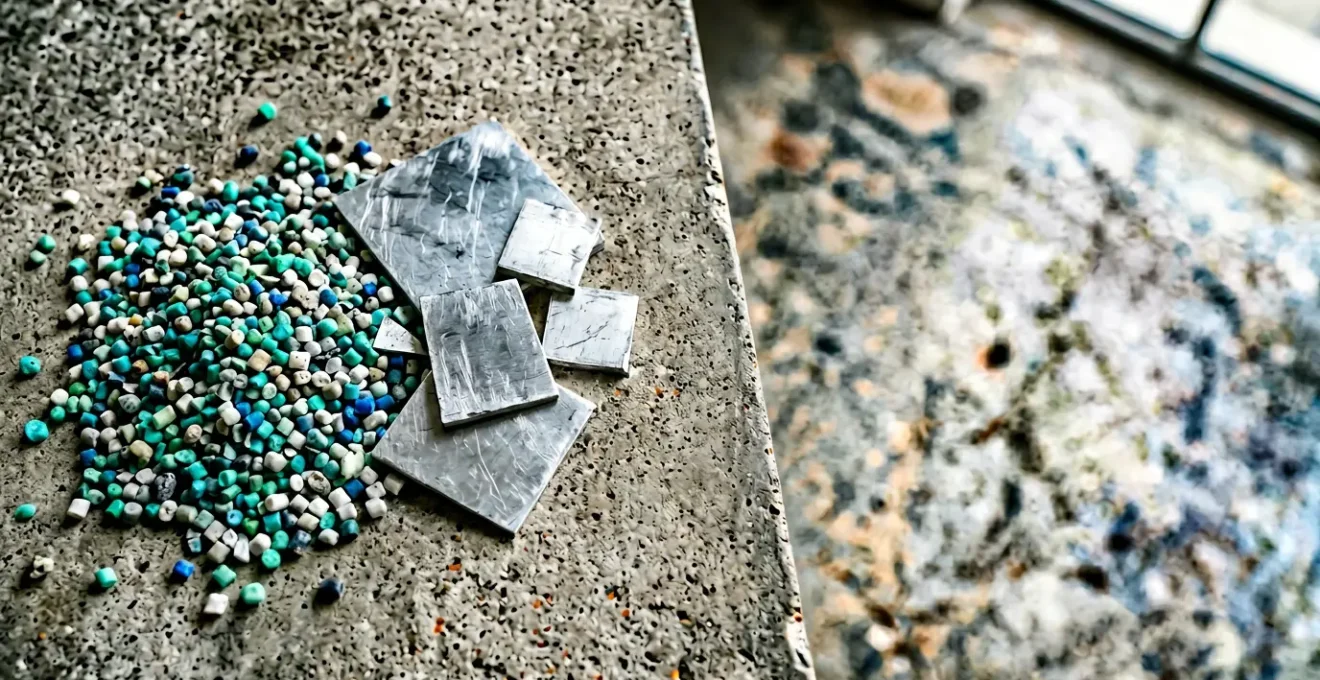
The “eco” label on your new device isn’t a guarantee of sustainability; it’s the start of an investigation into the product’s real-world impact.
- Recycled materials can have performance trade-offs, and their structural integrity must be questioned.
- Terms like “ocean plastic” require a verifiable chain of custody to have meaning.
- “Compostable” is a useless claim if your local Canadian waste management system can’t process it.
Recommendation: Instead of trusting logos, learn to evaluate a product’s material integrity, supply chain transparency, and actual end-of-life viability in your community.
You’re standing in the electronics store, faced with a choice. On one side, the standard model. On the other, the “Eco-Edition,” made with recycled ocean plastic, for a 15% premium. The packaging whispers promises of a cleaner planet. But a skeptical voice in your head asks: is this a genuine environmental contribution, or am I just paying a “green tax” for clever marketing? You’re not alone in this dilemma. As consumers, we’re encouraged to “buy recycled” and look for green logos, but we’re also bombarded with stories of corporate greenwashing, leaving us paralyzed by distrust.
The truth is, the answer isn’t a simple “yes, it helps” or “no, it’s a scam.” The real value of a “green” product isn’t found in its marketing copy, but in the verifiable science of its materials and the transparent logistics of its supply chain. But what if the key wasn’t just to trust the label, but to understand the fundamental questions that label is supposed to answer? What if you could assess a product’s claims like a materials scientist?
This guide moves beyond the buzzwords to give you a critical framework for evaluation. We will dissect the durability of recycled plastics, demystify the traceability of “ocean plastic,” and confront the practical end-of-life reality of “compostable” products within the Canadian system. By exploring material aesthetics, cost implications, and the eco-labels that actually matter, you’ll gain the confidence to distinguish authentic environmental efforts from hollow marketing hype.
To help you navigate these complex issues, this article breaks down the key questions you should be asking before you buy. Explore the topics below to become a more informed and empowered consumer.
Summary: Decoding the Truth Behind Green Gadgets
- Does recycled plastic crack easier than virgin plastic in consumer electronics?
- Traceability: How do brands prove their ocean plastic actually came from the ocean?
- The Mushroom Case: Can phone accessories really decompose in your backyard compost?
- The “Green Tax”: Why do devices with recycled materials cost 15% more?
- Speckled & Matte: Why eco-friendly materials look different and how to embrace the imperfection?
- Reusable Tote Bags: How to choose one that people will actually take to the grocery store?
- EPEAT vs. Energy Star: Which eco-labels actually guarantee a greener product?
- Embroidery vs. Screen Printing: Which Apparel Branding Lasts Longer in Canadian Wash Cycles?
Does Recycled Plastic Crack Easier Than Virgin Plastic in Consumer Electronics?
It’s a reasonable fear: you pay extra for an eco-friendly phone case, only for it to crack on the first drop. The question of durability, or material integrity, is central to evaluating recycled materials. The straightforward answer is that, yes, recycled plastics can have different properties than their virgin counterparts. The process of melting, shredding, and reforming plastic can shorten its polymer chains, which can affect its strength and resilience.
As materials experts at Oceanworks note, this can be a real factor in performance.
Recycled plastics can have reduced chemical, thermal, and impact resistance when compared to their virgin counterparts.
– Oceanworks, Performance analysis of recycled versus virgin plastics
However, this doesn’t mean all recycled products are inherently weaker. Reputable manufacturers mitigate this through advanced processing, blending recycled plastics with virgin materials, or using additives to restore performance characteristics. The key is that they design the product for its intended use, accounting for the specific grade of recycled material. A high-quality recycled material in a well-designed product can be just as durable. The trade-off is often weighed against significant environmental gains; for instance, an analysis by Tide Ocean shows that plastic recycling saves between 30% and 80% of the carbon emissions associated with virgin plastic production. The critical consumer question is not “is it recycled?” but “has this recycled material been engineered to meet the durability demands of this specific product?”
Traceability: How Do Brands Prove Their Ocean Plastic Actually Came From the Ocean?
The term “ocean plastic” evokes powerful imagery of cleaning up our seas. But without a system of verification, it’s just a marketing slogan. The crucial concept here is the chain of custody: a documented, auditable trail that tracks the material from its point of collection all the way to the final product on the shelf. This is how a brand proves its claims are legitimate.
Leading third-party certifiers have established strict definitions to prevent fraud. For example, “ocean-bound plastic” isn’t just any litter; it’s waste collected from specific at-risk zones. The collaboration between OceanCycle and UL, a global safety science leader, specifies that plastic must be collected within 30 miles of a coast or 200 miles along riverbanks that lead to the ocean. This prevents companies from simply relabeling standard industrial waste.
This verification process is rigorous. It involves auditors visiting collection sites, verifying the weight and type of plastic collected, and tracking it through every stage of sorting, cleaning, and processing. Some advanced methods even involve embedding microscopic tracers into the plastic pellets, creating a physical fingerprint that can be verified in the final product. For a consumer, the takeaway is clear: a vague claim of “made with ocean plastic” is not enough. A trustworthy brand will proudly point to its third-party certification and be transparent about its supply chain partners.
The Mushroom Case: Can Phone Accessories Really Decompose in Your Backyard Compost?
The promise of a product—like a phone case made from mycelium (mushroom root) or other bioplastics—returning to the earth is appealing. But the word “compostable” is one of the most misunderstood terms in green marketing. A product’s ability to decompose depends entirely on the conditions it’s exposed to. This is its end-of-life reality, and in Canada, that reality is highly localized.
Most “certified compostable” products are designed to break down in industrial or municipal composting facilities, which maintain high temperatures (55-65°C) that a backyard compost pile rarely achieves. While EREF-Canada research found that 71% of Canadian households have access to some form of organics program, access and capability vary wildly.
Case Study: The Canadian Composting Divide
The gap between urban and rural infrastructure highlights the issue. In major centres like Toronto, the Green Bin program can handle many certified-compostable materials. However, as analyses by BioCycle show, these programs are often unavailable in multi-unit buildings and are largely absent in rural and remote regions. This creates a scenario where a Torontonian can successfully compost a product that would simply persist in the environment or a backyard pile in a different part of Ontario. The product’s “compostability” is therefore conditional on the consumer’s postal code, not an inherent property.
Before you buy a “compostable” product, the essential question is: “Do I have access to a facility that can process this specific material?” Check your local municipality’s waste management guidelines. If their list of accepted materials for the “green bin” doesn’t explicitly include bioplastics or certified compostable packaging, then that product’s eco-friendly end-of-life promise is, for you, functionally void.
The “Green Tax”: Why Do Devices With Recycled Materials Cost 15% More?
It feels counterintuitive: if the material is recycled, shouldn’t it be cheaper? The price premium on eco-friendly products, often dubbed the “green tax,” is a real phenomenon driven by complex market and logistical factors. This is where we must consider lifecycle carbon accounting—the idea that cost isn’t just the final price tag, but the sum of all inputs across a product’s life.
First, collecting, sorting, cleaning, and processing post-consumer waste is a labour-intensive and technologically complex process. Establishing a certified, ethical chain of custody for materials like ocean-bound plastic adds further costs for audits and verification. Second, the market for high-quality recycled plastics (or “recyclates”) is volatile. When demand from sustainability-conscious brands outstrips the supply of clean, usable material, prices go up. In fact, industry analysts note a typical 10-20% premium for recycled resins over virgin plastic, a figure that can climb even higher. This premium reflects the true cost of reclamation.
So, what are you paying for? You’re paying for the infrastructure that diverts waste from landfills and oceans. You’re paying for the labour of collectors, often in developing nations, who are part of an ethical supply chain. And you’re funding the research and development required to turn that waste back into a high-performance material. While the virgin plastic it competes with may be cheaper at the point of purchase, its cost is externalized in the form of carbon emissions and environmental pollution. The “green tax” is essentially a user fee for a more responsible, circular manufacturing system.
Speckled & Matte: Why Eco-Friendly Materials Look Different and How to Embrace the Imperfection?
For decades, consumer electronics have strived for a flawless, uniform finish. A glossy, perfectly smooth surface was the mark of quality. Recycled materials often challenge this aesthetic, presenting with subtle speckles, a matte texture, or slight variations in colour. Rather than a defect, this is a sign of aesthetic authenticity—a visual cue of the material’s story.
The unique look is a direct result of the recycling process itself. As one industry analysis points out, it’s a feature, not a bug.
The unique speckled look is often the result of different coloured plastics being melted together, making it a visual proof of its recycled origin.
– Industry Analysis, Understanding recycled material aesthetics in promotional products
This visible “imperfection” is becoming a new kind of status symbol. It communicates a commitment to sustainability that a perfectly uniform product cannot. Manufacturers who once might have tried to hide the recycled nature of their materials are now leaning into it. They recognize that for a growing segment of consumers, authenticity trumps artificial perfection. As one manufacturer of promotional products made from Ocean Bound Plastic stated, these visual variations have become a “mark of authenticity,” helping to distinguish genuinely recycled items from their virgin plastic counterparts.
Embracing this new aesthetic is a shift in consumer mindset. It requires us to see beauty not in flawless uniformity, but in the story a material tells. A matte finish on a recycled aluminum body or the faint specks in a plastic casing are tangible evidence of a circular economy at work. They are the fingerprints of a more responsible manufacturing process, and learning to appreciate them is part of embracing a truly sustainable product.
Reusable Tote Bags: How to Choose One That People Will Actually Take to the Grocery Store?
The reusable tote bag is the quintessential corporate giveaway, yet most end up forgotten in a closet. Why? Because they often fail the most basic test: functionality. A truly sustainable product is one that gets used—repeatedly. The challenge is to move beyond token gestures and create items with real-world utility, a principle that is especially important when considering the scale of the plastic problem. With recent estimates indicating 170 trillion pieces of plastic floating in our oceans, every item we replace matters.
A successful reusable bag must be designed for life, not for a conference. This means considering factors like size, strength, and convenience. Is it large and sturdy enough for a full load of groceries? Does it have a wide, comfortable strap? Can it be folded compactly to fit in a purse or glove compartment? These practical details are what determine if a bag becomes a daily companion or gathers dust.
Case Study: The Functional Ocean Plastic Tote
One model for success is the Recycled Ocean Plastic Tote Bag. Beyond its measurable environmental impact—where each bag removes the equivalent of three plastic water bottles from waterways—its design directly addresses the functionality gap. The dimensions are purposefully chosen to be practical for both grocery shopping and travel. By prioritizing real-world usability over simple branding, it solves the core problem of corporate totes: it becomes an item people actually want and remember to use, thereby maximizing its positive environmental impact through repeated use.
When evaluating a reusable item, whether for personal use or as a corporate gift, the most important question is: “Is this designed to be used, or just to be seen?” Durability, thoughtful design, and user convenience are the true markers of a sustainable product, far more than the logo printed on its side. A bag that makes it to the grocery store every week is infinitely more “green” than a thousand bags that never leave the house.
EPEAT vs. Energy Star: Which Eco-Labels Actually Guarantee a Greener Product?
Navigating the sea of green logos, leaf icons, and “eco-friendly” badges is exhausting. To cut through the noise, it’s vital to distinguish between self-declared marketing fluff and rigorous, third-party certifications. Labels like Energy Star are well-known, but they typically focus on a single attribute: energy efficiency during use. More comprehensive labels provide a much deeper guarantee of a product’s environmental performance.
Two of the most robust standards in the electronics space are EPEAT (Electronic Product Environmental Assessment Tool) and UL ECVP 2809. These aren’t just simple pass/fail labels; they are multi-attribute rating systems that assess a product across its entire lifecycle. As the Canadian company Lavergne, a leader in recycled resins, states, “Programs like UL ECVP 2809 and the US Electronic Product Environmental Assessment Tool (EPEAT) are taking us in the right direction.” These standards are what separate genuine leaders from the greenwashers.
Case Study: HP’s Gold Standard for Ocean-Bound Plastic
In 2020, HP set a benchmark by becoming the first company to achieve UL 2809 validation for its use of ocean-bound plastics. This wasn’t just a claim about recycled content. The UL validation process involved a comprehensive audit of HP’s suppliers, including determining safe labor practices and risk mitigation at the plastic collection site in Haiti. This demonstrates how the best certifications extend beyond environmental metrics to include social responsibility, ensuring that the “green” product wasn’t made at the expense of human welfare.
When you see a label, don’t take it at face value. A truly meaningful certification will be from an independent, internationally recognized body and will cover multiple criteria, from material content and energy use to corporate responsibility and end-of-life management. Vague, self-made logos are red flags, while verifiable standards like EPEAT (which has Bronze, Silver, and Gold tiers) and UL 2809 are green lights.
Your 5-Point Checklist for Vetting an Eco-Label
- Identify the Claim: What exactly does the label certify? Is it recycled content, energy efficiency, ethical sourcing, or something else?
- Verify the Certifier: Is it a known, independent third-party (like UL, EPEAT, FSC) or just the brand’s own custom-designed “eco-logo”?
- Check for Specifics: Does the label provide a concrete percentage (e.g., “contains 85% post-consumer recycled content”) or use vague, unquantifiable terms like “eco-friendly” or “earth-smart”?
- Look for Lifecycle Scope: Does the certification cover just one aspect (like energy use during operation) or the entire product lifecycle, from materials sourcing to end-of-life options?
- Audit for Social Responsibility: For materials sourced from developing regions, does the certification process include audits for fair labor practices and ethical community engagement?
Key Takeaways
- The structural integrity of recycled plastics can differ from virgin materials; asking about performance testing is a valid part of a purchase decision.
- A legitimate “ocean plastic” claim must be backed by a verifiable chain of custody from a third-party certifier like UL.
- A product’s “greenness” is only as good as its end-of-life pathway in your specific Canadian municipality’s waste system.
Embroidery vs. Screen Printing: Which Apparel Branding Lasts Longer in Canadian Wash Cycles?
For branded apparel, longevity is sustainability. A garment that is worn for years has a much lower environmental footprint than one that fades or cracks after a few washes. In Canada, apparel faces unique challenges: high-heat dryers to combat humidity, hard water in many regions that can be harsh on fabrics, and the thermal stress of going from a cold winter day to a warm interior. When choosing between embroidery and screen printing, these factors are paramount.
Embroidery involves stitching the design directly into the fabric with thread. Its primary advantage is durability. The thread is colorfast and physically part of the garment, making it exceptionally resistant to fading, cracking, or peeling. It holds up remarkably well to repeated washing and the high heat of modern dryers.
Screen printing, on the other hand, involves applying a layer of ink (often plastisol-based) onto the surface of the fabric. While it allows for intricate, colourful designs, its longevity is more limited. The ink sits on top of the fibers and is more susceptible to the physical and chemical stresses of the laundry cycle. High heat can cause the ink to crack, and the minerals in hard water can interact with detergents to accelerate fading.
The following table breaks down the durability factors in a typical Canadian context.
| Factor | Embroidery | Screen Printing (Plastisol) |
|---|---|---|
| High-Heat Dryer Resistance | Excellent – stitching unaffected by heat cycles | Poor – ink cracks and fades with repeated high-heat exposure |
| Water Hardness Impact | Minimal – thread largely unaffected by mineral content | Moderate to High – hard water interacts with detergents causing faster ink degradation |
| Canadian Winter Durability | Superior – maintains integrity through frequent washing | Compromised – thermal stress from temperature extremes accelerates deterioration |
| Aesthetic Appeal | Premium, textured, professional | Smooth, vibrant initially but degrades |
| Cost | Higher initial investment | Lower upfront cost |
While screen printing may be more cost-effective for large orders, for a premium, long-lasting product that can withstand the rigors of Canadian wash cycles, embroidery is the clear winner. The higher initial investment is often justified by a significantly longer product life, aligning with a more sustainable approach to branded apparel.
The next time you’re faced with a ‘green’ choice, don’t just look at the logo or the price tag. Ask about the material science, demand to see the chain of custody, and understand its real end-of-life in your community. Your power as a consumer lies not in blind trust, but in informed skepticism. Begin applying this critical framework to your next purchase decision.