

For corporate procurement, the debate is over: the open-standard Qi2 is the only strategically sound, future-proof choice for wireless charging.
- Apple’s MagSafe creates a locked ecosystem, offering 15W charging only to iPhones, while the older Qi standard limits them to a slow 7.5W.
- Qi2 adopts MagSafe’s magnetic alignment and delivers 15W charging to both new iPhones and upcoming Android devices, eliminating compatibility headaches.
Recommendation: Prioritize sourcing Qi2-certified chargers for all corporate tech gifts to ensure universal compatibility, maximum performance, and long-term value for your investment.
As a tech buyer, you’re tasked with procuring premium gifts that delight and reflect well on your brand. Wireless chargers seem like a perfect fit—until you enter the confusing world of charging standards. You invest in a “15W Fast Charger” only to hear from your iPhone-using colleagues that it’s painfully slow. This isn’t a faulty product; it’s a feature of a fragmented ecosystem designed to perplex buyers.
The common advice is to “just buy MagSafe for iPhones and Qi for Android,” but this is an expensive and inefficient strategy for any organization. It doubles inventory and guarantees that some recipients will get a sub-par experience. The real issue lies in the proprietary “handshake” that devices use to unlock their full charging speed. Without the right certification, even the most powerful charger is throttled.
But what if the solution wasn’t about picking a side in the Apple vs. Android war? The key lies in understanding a newer, universal standard that is quietly rendering the old debate obsolete. This analysis moves beyond the spec sheet to frame your choice as a strategic decision in risk management. We will dissect the technical protocols, thermal impacts, and physical limitations to reveal why the emerging Qi2 standard is the only future-proof investment for a mixed-device corporate environment.
This guide will navigate the critical questions every Canadian tech buyer faces, from performance and battery health to compliance and brand safety. By exploring the technical nuances, we will build a clear framework for making a smart, universally compatible, and brand-safe procurement decision.
Contents: MagSafe vs. Qi: Which Wireless Charging Standard Is Future-Proof for Your Team?
- Why is my 15W wireless charger only charging my iPhone at 7.5W?
- Does wireless charging generate enough heat to degrade your battery health?
- Thick Cases: How many millimeters can a wireless charger penetrate?
- LED Nuisance: finding a charging station that doesn’t light up the whole bedroom?
- Foldable Stations: The best 3-in-1 chargers to pack for business trips?
- Android vs. Apple: How to choose a premium tech gift that works for everyone?
- Panel vs. Bank: Why your small solar power bank takes 40 hours to charge in the sun?
- Luxury Tech Gifts: How to Wow VIP Clients Without Looking Like a Bribe?
Why is my 15W wireless charger only charging my iPhone at 7.5W?
This common frustration is the single most important concept to grasp in wireless charging. The answer isn’t about power; it’s about communication. Your 15W charger is capable, but your iPhone refuses to accept more than 7.5W from it because it lacks the correct digital “handshake.” Apple reserves the full 15W speed for chargers that are either its own or are officially certified under the “Made for MagSafe” (MFM) program. This is a proprietary protocol.
A standard Qi charger, even one rated for 15W or more, cannot perform this MFM handshake. When an iPhone detects a non-certified charger, it defaults to the basic Qi standard’s maximum speed, which for iPhones is capped at 7.5W. An analysis of 7.5W for non-certified Qi chargers vs 15W for certified MagSafe confirms this performance gap is by design. The charger’s advertised wattage is irrelevant without the corresponding certification to unlock that speed on the device.
This is where the new Qi2 standard changes the game. Developed by the Wireless Power Consortium (WPC), Qi2 incorporates the Magnetic Power Profile from MagSafe into an open, universal standard. This means Qi2-certified chargers can perform the necessary handshake to deliver 15W of power to compatible iPhones (iPhone 13 and newer), just like MFM chargers. As of late 2024, flagship Android devices are also beginning to adopt Qi2, creating a unified high-speed standard for the first time. For a tech buyer, this means the end of the 7.5W bottleneck without being locked into Apple’s proprietary program.
Does wireless charging generate enough heat to degrade your battery health?
The second major concern for any tech deployment is longevity, and heat is the primary enemy of a lithium-ion battery. The short answer is yes, wireless charging inherently generates more heat than wired charging. The process of transferring energy via magnetic induction is less efficient, and that lost energy dissipates as heat. This effect is compounded by misalignment between the charging coils and the phone’s receiving coils, a common issue with non-magnetic chargers.
This excess heat can accelerate battery degradation. From an analyst’s perspective, the key is not whether heat is generated, but how it is managed. This is what I call “Thermal Sovereignty”: the ability of a well-engineered charging system to operate efficiently, minimize waste heat, and actively throttle power to protect the battery. Certified chargers (both MagSafe and Qi2) include stricter thermal monitoring and safety protocols. Cheaper, uncertified chargers often lack these sophisticated controls, leading to higher temperatures and faster battery aging.
The data clearly shows a performance difference in thermal impact. A comparative analysis highlights how different methods affect battery health.
| Charging Method | Temperature Increase | Degradation Impact |
|---|---|---|
| Wired Charging | Baseline | Standard wear |
| Wireless Charging | 5-10°C higher | Up to 25% faster degradation |
| Fast Wireless (15W+) | 10-15°C higher | Requires active cooling |
The takeaway for a procurement manager is clear: investing in certified chargers is a risk-management strategy for the longevity of your team’s devices. While a small premium may be paid upfront for MagSafe or Qi2 certification, it’s an investment in protecting a far more valuable asset—the device’s battery and its useful lifespan.
Thick Cases: How many millimeters can a wireless charger penetrate?
A charger’s effectiveness is not just about its internal electronics; it’s also about its ability to overcome physical barriers. The most common barrier is the phone case. Wireless charging relies on a precise distance between the transmitter coil (in the charger) and the receiver coil (in the phone). Any extra material in between weakens the magnetic field and reduces charging efficiency, which in turn can increase heat and slow down charging speeds.
As a general rule, most standard wireless chargers can effectively penetrate a case thickness of up to 3mm. Anything thicker, especially with ruggedized cases made of dense plastic or containing metal components (like kickstands or magnetic plates for car mounts), will likely prevent charging altogether. This 3mm limit is a standard specification for many corporate gift-grade chargers.
The following illustration provides a visual breakdown of how case thickness impacts the charging connection.
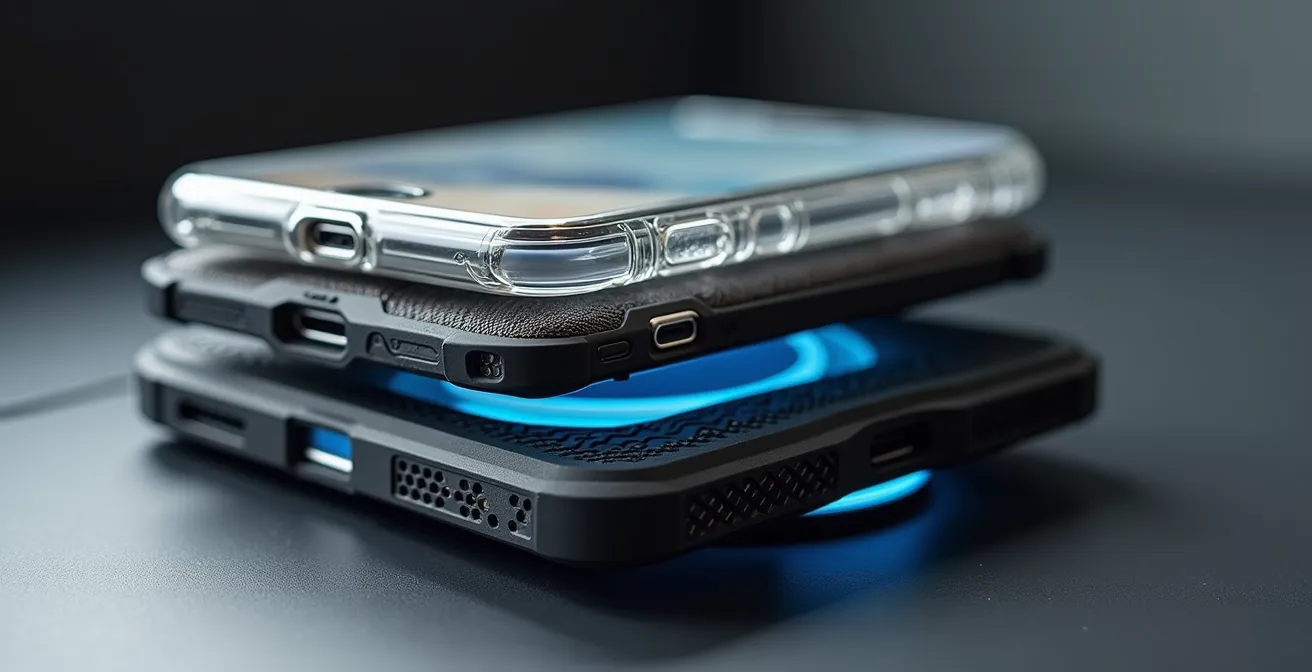
However, the introduction of magnetic standards like MagSafe and Qi2 has changed the equation. These systems don’t just transfer power; they ensure perfect alignment. A high-quality compatible case does more than just be “thin enough.” As the MagBak Engineering Team notes in their technical guide:
Most modern MagSafe-compatible cases do this by embedding their own magnets or leaving space for the phone’s magnets to engage with the charger. Cheap cases with weak N35 magnets or thick backs (3-4mm) will cause problems: poor hold, slow charging, and overheating.
– MagBak Engineering Team, MagBak Qi2 Technical Guide
This expert insight highlights that for magnetic charging, the quality and integration of magnets within the case are just as important as the thickness. For corporate gifting, this means recommending or bundling certified compatible cases with chargers to guarantee a seamless user experience.
LED Nuisance: finding a charging station that doesn’t light up the whole bedroom?
Beyond technical specifications, the user experience of a tech gift is paramount. One of the most frequently overlooked—and complained about—features of a wireless charger is its indicator light. A bright, blinking LED that is helpful on an office desk becomes a “nuisance light” on a bedside table, disrupting sleep and diminishing the perceived value of the gift. A premium tech product should integrate seamlessly into a user’s life, not annoy them.
Manufacturers of higher-end chargers are increasingly addressing this issue with more sophisticated lighting solutions. Instead of a simple on/off indicator, they are building in features designed for professional and personal environments. For instance, some premium chargers, particularly those designed for corporate settings in Canada, feature elegant materials like wood or fabric that diffuse light, offering a “soft, comforting glow” rather than a harsh glare. These models often have a non-slip base to ensure devices stay put, adding to their practical appeal.
When procuring chargers, especially for employees who may use them at home or while traveling, it’s wise to look for smart LED features. These turn a potential annoyance into a sign of thoughtful design. Key features to look for include:
- Chargers with ambient light sensors that automatically dim the LED in dark rooms.
- Models offering customizable brightness settings or color choices through a companion app.
- Units with a dedicated “sleep mode” that deactivates all lights after a few seconds or once the device is fully charged.
- Designs that use materials like wood or fabric to naturally diffuse and soften the indicator light.
Testing a sample unit in a darkened room before a bulk order is a simple but effective step in any procurement process. It ensures the chosen product enhances the user’s environment rather than detracts from it, reflecting positively on your brand’s attention to detail.
Foldable Stations: The best 3-in-1 chargers to pack for business trips?
For the modern professional, especially in Canada where business travel often spans multiple time zones, consolidating technology is key. A 3-in-1 charging station that can power a phone, watch, and earbuds simultaneously is an executive’s best friend. However, most are bulky and ill-suited for travel. The best travel-oriented chargers are defined by their compact, foldable design that minimizes space in a carry-on bag while maximizing utility.
These chargers transform from a full multi-device dock on a hotel desk to a slim, packable unit no larger than a wallet. This design ethos prioritizes efficiency and convenience for the user on the move.
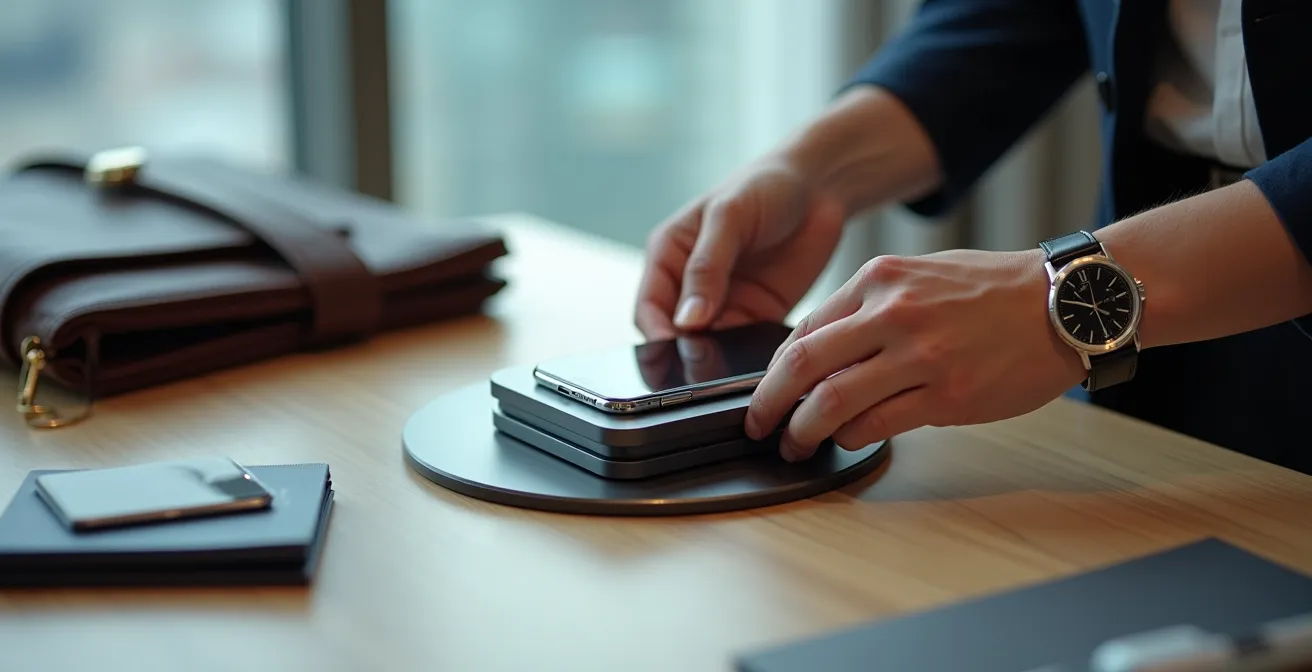
From a technical standpoint, a critical feature for any travel charger is its power adapter. It must support a universal voltage range to be functional globally. The accepted standard for international compatibility is a range of 100-240V, allowing it to work with power grids from North America to Europe and Asia without a voltage converter. Furthermore, for corporate deployment in Canada, it’s crucial to ensure these products meet local safety standards. Look for explicit CSA (Canadian Standards Association) or cUL (Underwriters Laboratories of Canada) approval. This certification is a non-negotiable mark of safety and compliance for any electronic device distributed within the Canadian market.
A well-chosen foldable 3-in-1 station is more than a charger; it’s a complete travel power solution. It reduces cable clutter, ensures all essential devices are ready for the day, and demonstrates a deep understanding of the modern professional’s needs. When selecting such a gift, prioritizing a compact foldable design, universal voltage support, and mandatory Canadian safety certifications will result in a product that is both highly practical and brand-safe.
Android vs. Apple: How to choose a premium tech gift that works for everyone?
This is the ultimate challenge in corporate gifting. Gifting a MagSafe charger to an Android user or a standard Qi charger to an iPhone user creates a “have and have-not” experience that undermines the gesture’s intent. The goal is universal appreciation, which requires a universally effective gift. Until recently, this was impossible in the wireless charging space. The solution, from an analyst’s standpoint, is to stop investing in legacy standards and focus entirely on Qi2.
The ESR Technical Team’s analysis puts it best, highlighting the strategic advantage of this new standard for any mixed-device environment.
One major advantage of Qi2 chargers is their compatibility with both iPhones and Android phones, making them an ideal choice for households and workplaces that use a mix of platforms. This universal compatibility ensures that Qi2 chargers are future-proof, as they will continue to work seamlessly with both iPhones and Android phones. Therefore, if you are looking for a charging solution that can cater to the diverse range of devices in your household or workplace, Qi2 chargers are the perfect choice.
– ESR Technical Team, ESR Qi2 vs MagSafe Analysis
The following matrix breaks down the compatibility landscape, visually demonstrating why Qi2 is the clear winner for future-proof, universal deployment.
| Standard | iPhone Support | Android Support | Max Power | Future-Proof |
|---|---|---|---|---|
| MagSafe | 15-25W (iPhone 12+) | Limited/None | 25W | Apple Only |
| Qi | 7.5W | Up to 15W | 15W | Legacy |
| Qi2 | 15W (iPhone 13+) | 15W (2024+ models) | 25W coming | Universal Standard |
By standardizing on Qi2, you are no longer choosing between Apple and Android. You are choosing a single, superior technology that provides the best-case charging scenario for new iPhones (15W with magnetic alignment) and is poised to do the same for the entire Android ecosystem. It is the definitive solution to the problem of platform diversity in a corporate environment, making it the smartest and safest investment for any tech gifting program.
Key takeaways
- The primary reason an iPhone charges slowly on a 15W charger is the lack of a “Made for MagSafe” or Qi2 certification, which acts as a digital handshake to unlock full speed.
- The new Qi2 standard is the strategic choice for corporate buyers as it provides 15W magnetic charging for both iPhones and new Android devices, solving the universal compatibility problem.
- For luxury corporate gifts in Canada, it’s crucial to consider brand values, sustainability (like B Corp certification), and compliance with the Canada Revenue Agency’s annual gift limit per recipient.
Panel vs. Bank: Why your small solar power bank takes 40 hours to charge in the sun?
In the push for sustainable corporate gifts, solar-powered power banks seem like an ideal choice. However, their real-world performance often falls drastically short of expectations, especially in a Canadian context. The tiny solar panels integrated into most portable power banks are more of a marketing feature than a functional charging method. Their small surface area is simply incapable of capturing significant solar energy.
Under ideal, direct sunlight in a sunny climate, these panels might be useful. But analysis shows that due to Canadian latitude and weather patterns, it can take 40+ hours of exposure to fully charge a typical power bank. This makes them impractical for their intended purpose and can lead to user disappointment, reflecting poorly on the gift. This isn’t a power bank versus a solar panel; it’s a recognition that integrated panels on small banks are ineffective.
A more authentic approach to sustainability in corporate gifting involves shifting focus from gimmicks to genuine impact. Instead of relying on inefficient solar panels, a better strategy is to select high-quality, high-capacity power banks from brands committed to verified sustainability practices. This ensures the gift is genuinely useful in an emergency while still aligning with corporate values. For Canadian companies, this means looking beyond the product itself to the entire supply chain.
Action Plan: Implementing an Authentic Sustainability Gifting Strategy
- Material Sourcing: Select products made from verified recycled materials, such as recycled plastic or aluminum, and request sourcing documentation.
- Supplier Verification: Partner with B Corp certified suppliers or those who are members of 1% for the Planet to ensure their business practices align with your values.
- E-Waste Responsibility: Implement a product take-back program aligned with provincial e-waste regulations, such as those managed by the Electronic Products Recycling Association (EPRA).
- Product Lifecycle: Choose suppliers that offer repair services to extend the product’s usable life, reducing waste and enhancing long-term value.
- Carbon Offsetting: Integrate a carbon offset program with each tech gift, making a measurable contribution to environmental projects.
By focusing on these verifiable actions, a company can offer a tech gift that is not only practical and high-performing but also a true reflection of a commitment to sustainability.
Luxury Tech Gifts: How to Wow VIP Clients Without Looking Like a Bribe?
When gifting to VIP clients or key partners, the goal is to show appreciation and strengthen relationships, not to create a sense of obligation or, worse, violate ethical guidelines. A luxury tech gift should be impressive in its thoughtfulness and quality, not just its price tag. The key is to balance premium feel with personalization and brand alignment, all while staying within acceptable business practice guidelines.
In Canada, there are specific financial regulations to consider. The Canada Revenue Agency (CRA) guidelines specify a $500 CAD annual limit per recipient for business gifts to be fully tax-deductible and to avoid being considered income for the recipient. This provides a clear financial ceiling. The art of luxury gifting lies in maximizing perceived value and personal relevance well below this threshold.
Instead of choosing the most expensive item, the focus should be on gifts that tell a story and align with both your brand’s and your client’s values. A powerful strategy is to select products from purpose-driven brands.
Case Study: The Hybrid Work Power Kit
A Canadian consulting firm wanted to gift a premium “Work from Anywhere” kit to its top clients. Instead of a generic high-end charger, they chose a wireless charging pad from Nimble, a certified B Corporation. The pad is made from recycled silicone and is paired with a high-efficiency 20W wall charger. The gift’s value proposition wasn’t just its 15W charging speed; it was the fact that Nimble is a Climate Neutral certified company and a 1% For the Planet member. The gift communicated quality, performance, and a shared commitment to corporate responsibility, making it far more memorable than a more expensive but generic alternative.
As noted by Canadian gifting experts, “Personalization and branding that reflects Canadian values transforms a simple tech gift into a statement of shared principles.” This can be achieved by co-branding the item, including a personalized note explaining the choice of a sustainable brand, or presenting it in locally sourced, eco-friendly packaging. By focusing on shared values, quality, and thoughtful presentation, a luxury tech gift can be both impressive and appropriate, strengthening business relationships in an authentic way.
Ultimately, making the right choice in tech gifting comes down to shifting your perspective from a consumer to a strategist. By prioritizing the universal, future-proof Qi2 standard and aligning your choices with authentic brand values and Canadian compliance, you can deliver a gift that is not only powerful and practical but also a lasting symbol of a smart, forward-thinking partnership.