
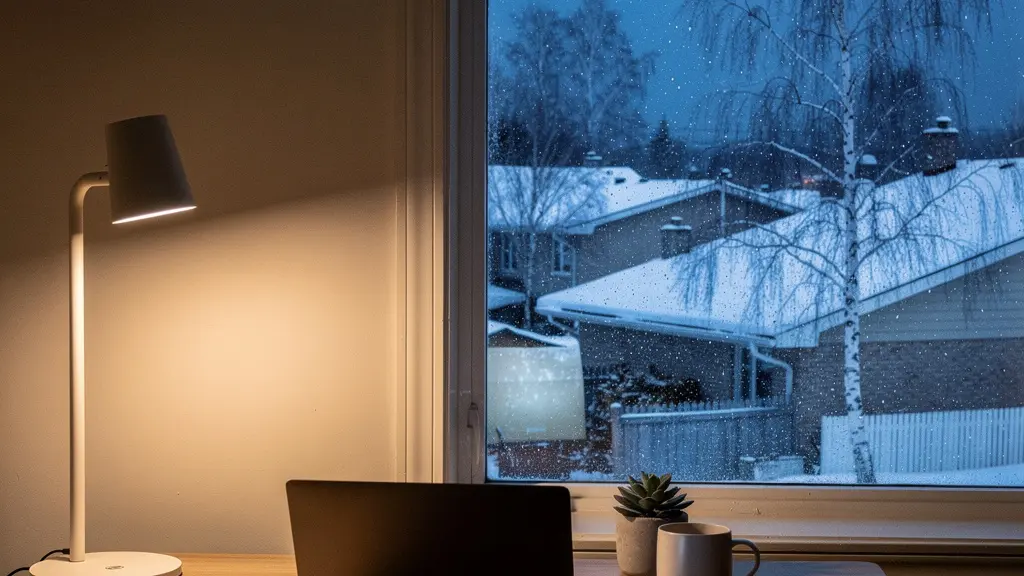
Fighting the Canadian winter blues isn’t just about a ‘happy light’; it’s about architecting your entire home’s light environment to give your brain the signals it’s missing.
- The quality of light (CRI) is more important than just brightness for avoiding a sterile, fatiguing atmosphere that mimics a hospital.
- Syncing your light’s color temperature to the sun’s natural cycle (circadian rhythm) directly impacts your energy, focus, and sleep quality.
Recommendation: Start with one high-CRI, tunable white smart bulb in your primary workspace to feel the immediate difference in mood and focus.
The hum of the furnace is a constant companion. Outside, a world of monochromatic grey presses against the small basement window. For many Canadians working remotely, especially from a subterranean office, the arrival of February brings a familiar, heavy blanket of fatigue known as the “winter blues.” The common advice is predictable: take some vitamin D, maybe buy a basic light therapy lamp from an online marketplace. But these are often just isolated tactics, like putting a bandage on a complex problem.
These solutions overlook a fundamental truth: as humans, our bodies are deeply wired to respond to the natural cycles of sunlight. When you spend your days in a space deprived of this essential ‘light nutrition,’ your energy, mood, and even your sleep can suffer profoundly. The flat, lifeless glare of cheap LED bulbs only makes it worse, creating a subconscious sense of unease and strain. What if the solution wasn’t just about adding a single bright light, but about transforming your entire home into an environment that actively supports your well-being?
This is where strategic smart lighting transcends being a mere gadget. The true key isn’t just having lights you can control from your phone; it’s about becoming the architect of your own sensory environment. It’s about using light as a tool to send the right signals to your brain at the right time, effectively recreating the lost rhythms of a natural day. This is a more profound approach that can have a measurable impact on your mental and physical state during the longest, darkest months.
This guide will walk you through exactly how to implement this neuro-architectural lighting strategy. We will explore why the quality of your light matters more than you think, how to program your lights to enhance wakefulness and promote restful sleep, and the practical considerations for integrating this technology, even in an older Canadian home. It’s time to move beyond the simple on/off switch and start designing a home that works for you.
Table of Contents: A Guide to Architecting Your Light for Wellness
- Why your cheap LED bulbs make your home feel like a hospital waiting room?
- Waking Up: How a gradual light fade-in outperforms a blaring alarm clock for mood?
- Ambilight Clones: Is it worth syncing your living room lights to your TV for movies?
- The $50 Bulb: How long does it take for a smart bulb to pay for itself in saved hydro?
- No Neutral Wire: How to install smart switches in a 1950s Canadian bungalow?
- Tunable White Light: How changing light warmth throughout the day improves sleep?
- Smart Lighting for Focus: How changing color temperature signals your brain to work?
- Why a High CRI Smart Lamp Is the Best Investment for Canadian Winters?
Why your cheap LED bulbs make your home feel like a hospital waiting room?
You’ve replaced all your old incandescent bulbs with energy-efficient LEDs, but something feels off. Your living space, meant to be a cozy refuge, has a sterile, clinical feel. The colours of your decor seem dull and lifeless. This isn’t your imagination; it’s the result of a metric called the Color Rendering Index (CRI). CRI measures how accurately a light source reveals the true colours of objects compared to natural sunlight. A score of 100 is perfect, like the sun at noon. Most cheap, generic LED bulbs have a CRI of around 80, which is passable but far from ideal.
This low-quality light omits crucial parts of the colour spectrum. It’s like listening to a song with half the notes missing—your brain notices the absence, even if you can’t pinpoint why. This incomplete spectrum is what causes that harsh, flat “hospital waiting room” effect. It can lead to subtle eye strain and a feeling of being in an artificial, uninviting environment. For someone already struggling with the winter blues, this constant, low-level sensory dissonance can exacerbate feelings of being disconnected and confined.

Investing in high-CRI bulbs (90 or above) is the single most impactful change you can make. Suddenly, the reds in your favourite blanket are rich and vibrant, skin tones look healthy and natural, and your entire space feels warmer and more welcoming. This isn’t just an aesthetic upgrade; it’s about providing your eyes and brain with the full-spectrum “light nutrition” they crave. As researchers have noted, the quality of light is directly tied to our perception of comfort. According to a 2022 study, a light source with a larger CRI is closer to natural light and provides demonstrably better visual comfort. This simple switch is the foundational step in turning your home from a source of stress into a sanctuary.
Waking Up: How a gradual light fade-in outperforms a blaring alarm clock for mood?
That jarring, sudden blare of an alarm clock in a pitch-black room is one of the most unnatural ways to start the day. It jolts your system from deep sleep into high alert, triggering a spike in stress hormones. This phenomenon, known as sleep inertia, is that groggy, disoriented feeling that can linger for an hour or more, tanking your mood and productivity before your day has even begun. During the dark Canadian winter mornings, this effect is amplified, making it even harder to leave the warmth of your bed.
A far more humane and effective method is the sunrise simulation, a core feature of many smart lighting systems. By programming your bedroom lights to begin fading in from a dim, warm red to a bright, cool white over 30 minutes, you mimic a natural dawn. This gradual increase in light intensity sends a gentle signal to your brain to ease up on melatonin (the sleep hormone) and start producing cortisol (the wake-up hormone) in a controlled, natural ramp-up. You wake up feeling more refreshed, alert, and with a significantly better mood because your body has been prepared for wakefulness, not shocked into it.
The wellness benefits of such devices are so recognized that they are now being considered in professional contexts. For individuals with diagnosed Seasonal Affective Disorder (SAD), these tools are more than a convenience. As noted by Canadian employment law firm SpringLaw, non-cash wellness items like light therapy devices can be framed as a reasonable accommodation under provincial human rights legislation. Their analysis highlights how employers can use the CRA’s $500 annual gift exemption to provide tools like dawn simulators to support employee well-being, blending tax compliance with their duty to accommodate. This underscores that controlling your morning light is a legitimate and powerful strategy for managing mood.
Ambilight Clones: Is it worth syncing your living room lights to your TV for movies?
When you’re confined indoors during a long winter, your living room becomes your cinema, your sanctuary, and your escape. Syncing your smart lights to your TV, a feature popularized by Philips Ambilight and now available through various “clone” systems, can seem like a gimmick. However, when viewed through the lens of combating the winter blues, it takes on a new level of purpose. This technology uses smart lights placed behind your TV to cast colours onto the wall that mirror the on-screen action, effectively extending the visual experience beyond the confines of the screen.
The primary benefit is reduced eye strain. When watching a bright screen in a dark room, your pupils are constantly adjusting, which can lead to fatigue and headaches. An ambient bias light creates a softer gradient between the screen and the surrounding wall, allowing your eyes to relax. But the psychological benefit is arguably more important. The immersive wash of colour makes the viewing experience more engaging and transportive. For someone struggling with the gloom of winter, creating a rich, dynamic, and captivating home entertainment environment is a powerful form of self-care. It transforms a passive activity into an active, sensory experience.
This need for more engaging indoor experiences is particularly acute in Canada, where the “winter blues” are a significant issue. As documented by Relief, a Canadian mental health research foundation, an estimated 20% of the Canadian population has symptoms of this seasonal mood slump. Creating an immersive home environment becomes a key strategy for well-being. Wellness design consultancies like Biofilico have deployed these exact systems in commercial wellness spaces in Calgary, using dynamic lighting to create specific moods. They use connected bulb systems to shift from energizing daytime light to warm, relaxing hues for evening, reporting improved focus and sleep as key benefits—a model directly applicable to enhancing home life during long winter nights.
The $50 Bulb: How long does it take for a smart bulb to pay for itself in saved hydro?
Let’s be direct: if you’re buying a $50 smart bulb solely to save money on your hydro bill, you’re focusing on the wrong return on investment. Yes, a modern LED smart bulb uses slightly less energy than a generic “dumb” LED and significantly less than an old incandescent. You might save a few dollars a year, especially if you’re diligent about using timers and dimming features. But the payback period in pure electricity savings could stretch for a decade or more. The true value of that $50 investment isn’t measured in kilowatts; it’s measured in well-being.
Think of it as an investment in your mental and physical health. For the price of a few fancy coffees, you gain the ability to do the following:
- Regulate your sleep cycle: Use sunrise simulation to wake up gently and program warm, dim light in the evening to promote melatonin production.
- Boost your focus: Flood your workspace with bright, cool-toned light during work hours to increase alertness and concentration.
- Improve your mood: Eliminate the harsh, fatiguing glare of low-CRI bulbs and bathe your space in full-spectrum, natural-feeling light.
This isn’t a frivolous luxury; it’s a wellness tool. The Canadian government’s own tax policies offer a useful perspective on this. Under the Canada Revenue Agency’s (CRA) administrative policy, employers can give employees up to $500 per year in non-cash gifts on a tax-free basis. This policy is often used for wellness-related items. The fact that a high-quality smart lighting system could fall under this corporate wellness umbrella shows that its value is increasingly recognized beyond simple utility. When you reframe the cost from a simple utility expense to a wellness investment, the “payback” is immediate—it begins the first time you wake up feeling refreshed instead of groggy, or finish a workday feeling focused instead of drained.
No Neutral Wire: How to install smart switches in a 1950s Canadian bungalow?
You’re inspired to upgrade your home’s lighting, but you live in a classic post-war Canadian bungalow, common in neighbourhoods from Etobicoke to Calgary’s Renfrew. You open up a light switch, hoping for a simple installation, and find a confusing tangle of wires—and crucially, no “neutral” wire. This is a common scenario in older Canadian homes (pre-1980s), and it can stop a DIY smart home project in its tracks. Most smart switches require a neutral wire to draw a small amount of power to stay connected to your network. Ignoring this reality isn’t just an inconvenience; it can be a serious safety hazard.
Homes from this era can have outdated wiring like knob-and-tube or brittle aluminum, which require professional handling. Furthermore, disturbing walls to access electrical boxes could release asbestos fibres from old plaster or drywall compounds. This isn’t a simple weekend project; it’s a job that demands expertise and adherence to the Canadian Electrical Code (CEC). The good news is that solutions exist. Companies like Lutron offer “no-neutral-required” smart switches designed specifically for these situations. However, installation should almost always be left to a licensed professional.
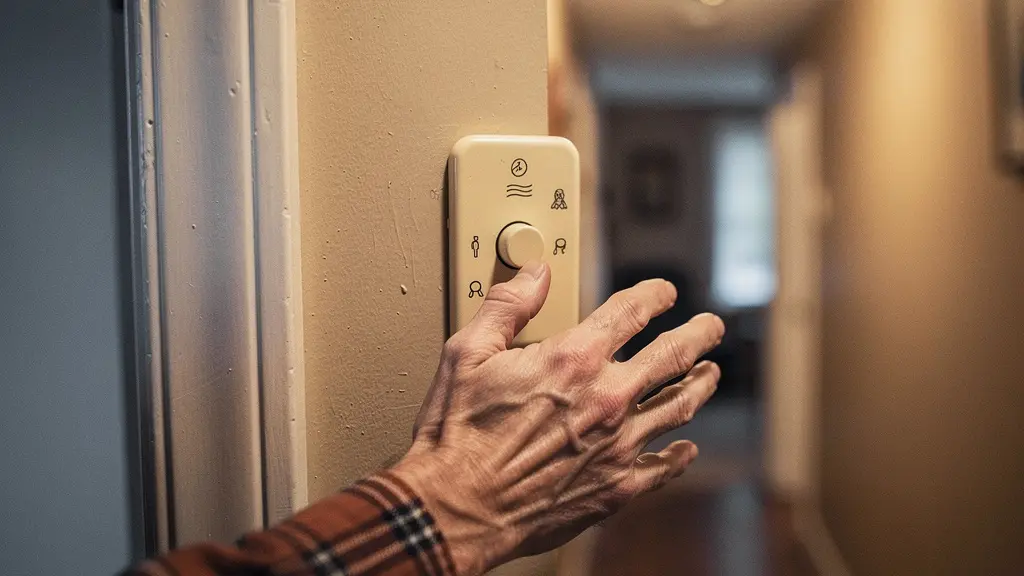
Before you even purchase a switch, it’s critical to follow a safety-first protocol. Altering the wiring in a home with older systems like knob-and-tube without a professional’s sign-off can even void your home insurance policy. The investment in a licensed electrician isn’t an “extra cost”—it’s an essential part of the project’s budget to ensure the safety of your home and family, and to guarantee the system is CSA-certified and compliant.
Your Action Plan: Safe Smart Switch Installation in an Older Canadian Home
- Assess Wiring Type: Identify if your home has knob-and-tube (KT), aluminum, or copper wiring. Post-war Canadian bungalows, especially in areas like Scarborough or Vancouver’s Kitsilano, may have KT remnants that make DIY installation unsafe.
- Check Insurance Implications: Contact your home insurer before modifying any electrical installation. Many Canadian insurers can void coverage for homes with altered knob-and-tube wiring if not certified by a licensed electrician.
- Hire a Licensed Electrician: For CEC compliance, hire a provincially licensed electrician to verify compatibility. Budget $150–$300 per switch for professional installation, especially if a neutral wire is absent.
- Test for Asbestos in Walls: In pre-1980s homes, be aware that disturbing walls might release asbestos from drywall compound. If significant wall work is needed, a professional assessment is crucial.
- Choose No-Neutral-Wire Switches: Select smart switches specifically designed for this scenario (e.g., Lutron Caseta) and ensure they are CSA-certified for use in Canada.
Tunable White Light: How changing light warmth throughout the day improves sleep?
For millennia, the human body has operated on a simple, powerful rhythm dictated by the sun. Bright, blue-rich sunlight in the morning signals “it’s time to be alert.” The warm, dim, red-toned light of sunset signals “it’s time to wind down.” This is our circadian rhythm, an internal 24-hour clock that governs everything from our sleep-wake cycles to our mood and metabolism. In the modern world, and especially when confined to a basement in winter, we’ve broken this connection. We stare at the same static, artificial light from morning until night, sending confusing signals to our brains.
Tunable white smart light allows you to restore this essential rhythm. The concept is simple: you program your lights to change their color temperature throughout the day to mimic the sun. In the morning and during your workday, you set the lights to a cool, blue-white (4000K-5000K). This high-Kelvin light suppresses melatonin production, promoting alertness and focus. As evening approaches, you program the lights to automatically shift to a very warm, amber-like glow (2200K-2700K). This low-Kelvin light is free of the blue spectrum that inhibits melatonin, allowing your body to naturally prepare for sleep. As Canadian psychiatrist Dr. Raymond Lam, an expert on seasonal depression, stated in an interview on CBC Radio, when it comes to the biological effect of light, “The key ingredient is really the intensity of light.” By managing both the intensity and color temperature, you give your body the clear, unambiguous signals it needs.
The key ingredient is really the intensity of light.
– Dr. Raymond Lam, CBC Radio — The Dose
This isn’t a minor tweak; it’s a fundamental aspect of sleep hygiene. Improving sleep quality is one of the most powerful levers for improving mental health, a significant concern in Canada where about 11% of men and 16% of women will experience major depression in their lifetimes, according to Statistics Canada. By using tunable white light to honor your body’s natural clock, you are taking a proactive step to support better sleep and, by extension, a more resilient mood.
Smart Lighting for Focus: How changing color temperature signals your brain to work?
That mid-afternoon slump is a familiar feeling, especially when the world outside is dark and grey. You find yourself re-reading the same email, your mind drifting. This dip in energy is often tied to your environment. A dimly lit or overly “cozy” workspace sends signals to your brain that it’s time to relax, not to concentrate. To maintain peak cognitive performance, you need to provide your brain with the right kind of environmental cue: bright, cool-toned light.
This is the other side of the circadian rhythm coin. Just as warm light signals relaxation, light in the blue-to-white spectrum (around 4000K to 5000K) acts as a powerful stimulant for your brain. It mimics the quality of light found on a bright, clear day, which our bodies interpret as a signal for peak alertness. Research has consistently shown that exposure to this type of light can improve concentration, reduce errors, and combat feelings of drowsiness. In office settings, environments with higher quality, high-CRI lighting have been linked to improved concentration and reduced eye strain during periods of prolonged artificial light exposure.
For a remote worker in a Canadian basement, this is a game-changer. Your workspace may receive zero natural daylight, making you entirely dependent on artificial sources. As wellness design consultants at Biofilico explain, a smart circadian lighting system is particularly critical in these below-grade offices common in cities like Calgary, Ottawa, and Winnipeg. Their protocol for home offices involves using energizing blue-white spectrum light (5000K+) during morning and afternoon hours to boost mental alertness. You can program a “Focus” scene in your smart lighting app that, with one tap, shifts your office lights to a bright, crisp 4500K. This simple change acts like a cup of coffee for your brain, sending a clear, biological signal that says, “It’s time to work.”
Key Takeaways
- Light quality (CRI > 90) is non-negotiable for visual comfort, accurate colour rendering, and reducing subconscious strain.
- Match your light’s color temperature to the time of day—cool white for focus, warm amber for relaxation—to support your natural circadian rhythm.
- In older Canadian homes, hiring a licensed electrician for smart switch installation is a safety essential, not a luxury.
Why a High CRI Smart Lamp Is the Best Investment for Canadian Winters?
We’ve explored the science of color temperature and the practicality of installation. Now, let’s synthesize it all into one core conclusion: for a Canadian struggling with the winter blues, a high-quality, tunable smart lighting system is one of the best wellness investments you can make for your home. It moves beyond passive illumination and becomes an active tool for regulating your mood, energy, and sleep in an environment starved of natural light.
This isn’t just a hypothesis; it’s backed by a significant body of evidence on the efficacy of light therapy for treating Seasonal Affective Disorder (SAD). While a smart lighting system isn’t a replacement for a clinical 10,000-lux therapy lamp, it functions as the essential, day-long support system that makes formal therapy more effective. According to the Canadian Mental Health Association (CMHA), people with SAD make up about 10% of all depression cases in Canada, and a remarkable 60-80% of them find substantial relief from light therapy. Your smart lighting system maintains a high-quality, biologically supportive light environment throughout the entire day, complementing the intense dose from a morning therapy session.
This system acts as your personal sun. It provides a gentle dawn to wake you peacefully, a bright, clear “midday” to keep you focused at work, and a warm, soft “sunset” to help you unwind and prepare for restorative sleep. It brings the rhythm of nature back into your life, even when you’re three floors below ground in the dead of winter. It’s an investment in fewer groggy mornings, more productive afternoons, and more restful nights. It’s about architecting a space that doesn’t just shelter you from the winter, but actively helps you thrive through it.
Your environment profoundly impacts how you feel. Start today by choosing one room—your office—and invest in a single, high-quality smart light. Experience the change for yourself and begin architecting a home that actively nurtures your well-being.
Frequently Asked Questions About Smart Lighting and Wellness in Canada
Can a corporation gift a high-CRI smart lamp to employees tax-free in Canada?
Yes. Under CRA administrative policy, non-cash gifts with a combined fair market value of $500 or less (including taxes) per year are non-taxable, provided they are given for a special occasion such as a holiday or birthday and are not performance-related rewards. A high-CRI smart lamp valued under $500 qualifies if all conditions are met.
What CRI level is recommended for home offices to combat winter blues?
Lighting experts recommend a CRI of 90 or above for spaces where accurate colour rendering and visual comfort are important. For Canadian winters, a CRI of 95+ most closely replicates natural daylight, helping counteract the monochromatic grey landscape and supporting mood regulation during the darkest months.
Does light therapy actually work for Seasonal Affective Disorder?
According to the Canadian Mental Health Association, 60-80% of people with SAD find substantial relief from light therapy. Sessions typically involve sitting near a 10,000-lux light device for approximately 30 minutes per day, ideally in the morning. A high-CRI smart lamp complements formal light therapy by maintaining quality ambient lighting throughout the day.