

In Canada’s cooling real estate market, smart home tech isn’t an amenity—it’s a core infrastructure investment that directly boosts net operating income and defends property value.
- Choosing the right ecosystem (Alexa vs. Google) has major market appeal implications for specific Canadian buyer demographics.
- Future-proofing with proper wiring (conduit, C-wires, tech closets) prevents million-dollar lawsuits and ensures long-term value that depreciating gadgets cannot.
Recommendation: Focus on building ‘digital equity’ through robust infrastructure, not just installing devices, to create a branded, high-value asset that stands out.
In the competitive Greater Toronto and Vancouver real estate markets, the pressure to differentiate is immense. For years, the developer’s playbook has been predictable: granite countertops, stainless steel appliances, and premium flooring. But as the market cools and buyer expectations evolve, these features are no longer differentiators; they are the baseline. Many developers have turned to smart home technology, dotting their units with a smart thermostat here and a video doorbell there, hoping to capture the attention of a tech-savvy generation. This approach, however, is a short-term tactic in a long-term game.
This gadget-centric strategy misses the fundamental shift occurring in residential real estate. The real, defensible value isn’t in the disposable, fast-depreciating devices. It’s in the unseen infrastructure that supports them. What if the most crucial decision isn’t which brand of smart lock to install, but whether you’ve created a future-proofed digital backbone for the entire building? The key to unlocking a genuine 15% or more in value appreciation lies in moving from offering smart gadgets to building in permanent digital equity—a core utility as essential as plumbing or electricity.
This guide moves beyond the platitudes of “tech is the future.” We will provide a strategic framework for Canadian developers to turn smart home integration from a marketing expense into a significant profit driver and liability shield. We will analyze the critical decisions, from choosing a voice assistant ecosystem tailored to the Canadian market and future-proofing your wiring to avoid costly mistakes, to navigating digital ownership transfers and mitigating the hidden risks of device obsolescence. It’s time to stop decorating with tech and start building with it.
In this comprehensive guide, we’ll break down the strategic pillars for implementing smart home technology that not only attracts buyers today but also holds its value for years to come. The following sections will provide actionable insights for every stage of your development project.
Summary: A Developer’s Strategic Guide to Smart Home ROI in Canada
- Google Home vs. Amazon Alexa: Which ecosystem appeals most to Canadian homebuyers?
- How to transfer digital ownership of a smart home to new tenants without liability?
- Mistakes to avoid when wiring a new build for future smart automation
- Smart Locks and Thermostats: Are they the new granite countertops for buyers?
- Who pays when the smart fridge software becomes obsolete after 5 years?
- Which devices consume power even when turned off (and how to stop them)?
- The “C-Wire” Problem: How to install a smart thermostat without a common wire?
- Can Smart Lighting Actually Cure Your “February Blues” in Canada?
Google Home vs. Amazon Alexa: Which ecosystem appeals most to Canadian homebuyers?
The first major strategic decision is not which device to install, but which digital ecosystem to build into your development. This choice dictates compatibility, user experience, and long-term appeal. In Canada, the market is dominated by two key players: Amazon’s Alexa and Google’s Home/Nest. While Apple’s HomeKit holds a premium, privacy-focused niche, its limited hardware partnerships make it a less scalable choice for large-scale developments aiming for broad appeal.
The decision between Alexa and Google is a bet on a specific buyer persona. Amazon Alexa, with its commanding market share and partnerships with Canadian telecom giants like Bell and Rogers, represents the path of least resistance. It offers mass-market convenience and a high degree of familiarity for the average Canadian household. This makes it a safe, reliable choice for developments targeting a broad demographic, from young families to downsizers.
Google Home, conversely, often appeals more to the tech-savvy buyer who values deep integration and a more seamless data experience across devices. With strong support from TELUS and Shaw, the Google ecosystem is often perceived as more sophisticated, making it an excellent choice for developments targeting urban professionals or those looking to brand their units as “tech-forward.” Both ecosystems offer full bilingual support in English and French, a non-negotiable feature for the Canadian market. Choosing the right one is about aligning your brand with your target buyer’s technological identity. A detailed market analysis shows the current landscape and partner networks that are crucial for developers to consider.
| Ecosystem | Market Share (2024) | Key Canadian Partners | French Support | Developer Appeal |
|---|---|---|---|---|
| Amazon Alexa | 52% (voice assistant) | Bell, Rogers | Full bilingual | Mass market convenience |
| Google Home | 31% (voice assistant) | TELUS, Shaw | Full bilingual | Tech-savvy integration |
| Apple HomeKit | 17% (voice assistant) | Limited partnerships | Siri bilingual | Premium privacy focus |
How to transfer digital ownership of a smart home to new tenants without liability?
Installing smart home technology is only half the battle; transferring ownership to the new buyer or tenant without inheriting a mountain of digital liability is where strategic planning becomes critical. A haphazard handover process can lead to significant privacy breaches, security vulnerabilities, and legal claims down the road. You are not just handing over keys to a physical space, but administrative access to a network of data-collecting devices. This requires a formalized, documented, and secure protocol.
The core principle is to treat the handover like a legal transaction. All devices—from locks and thermostats to light switches and appliances—must be inventoried with their associated accounts. Before the possession date, a full factory reset is mandatory. This act severs all ties to developer or staging accounts, ensuring a clean slate for the new owner. Never transfer ownership of a personal or corporate account used for setup; instead, create temporary “handover accounts” that can be safely deleted post-transfer.
Providing new owners with a sealed package containing temporary credentials and setup guides is a professional touch that also serves as a documented part of the transfer. Crucially, the process must culminate in a written acknowledgment from the new owner confirming they have received administrative control and that the developer is released from future responsibility for account management. This single document is your most powerful tool in mitigating future liability claims related to data privacy or device access.
Case Study: Tridel’s Proactive ‘Tridel Connect’ System
Major Canadian developer Tridel provides a masterclass in managing this risk at scale with their “Tridel Connect” system. They pre-install neutral smart home infrastructure that is not tied to any specific account. Upon purchase, buyers customize and create their own accounts, completely bypassing the need for complex and risky account transfers. This innovative model has reportedly reduced liability claims by 78% while simultaneously boosting buyer satisfaction scores by giving them full autonomy from day one.
Your Digital Handover Protocol Checklist
- Document & Inventory: List all smart devices and their admin accounts in a master sheet, ensuring compliance with Canadian privacy laws like PIPEDA.
- Perform & Record Factory Reset: Execute a factory reset on all devices 48 hours before the possession date, documenting the process with timestamps and photos.
- Create Neutral Handover Accounts: Generate new, single-purpose accounts for the transfer, completely separate from any personal or corporate developer credentials.
- Provide a Sealed Onboarding Package: Give new owners a sealed envelope with temporary passwords, QR codes, and clear instructions for initial device setup.
- Conduct a Guided Walkthrough: Schedule a brief session with new owners to actively transfer admin rights and verify all systems are functional under their new control.
- Obtain Written Acknowledgment: Secure a signed document from the owner acknowledging the successful transfer of all digital assets and associated responsibilities to limit future liability.
Mistakes to avoid when wiring a new build for future smart automation
The single greatest mistake a developer can make is viewing smart technology as a finish to be applied late in the construction process. True smart homes are built from the bones out. The wiring and infrastructure you install—or fail to install—during the framing stage will determine the property’s technological viability and value for decades. Retrofitting is exponentially more expensive and disruptive than getting it right from the start. This foundational layer is your ‘digital equity’.
The most critical element is moving beyond simply running cables. Installing conduit to key locations (e.g., thermostat, main TV wall, security camera points) is a non-negotiable for future-proofing. A conduit allows for easy upgrades—from CAT6 to fiber optic cable, for instance—without ever having to open up the walls again. Another common but costly error is neglecting to run a neutral wire (the “C-wire”) to every thermostat location. As we’ll see later, its absence can lead to catastrophic system failures and is now a requirement under the Canadian Electrical Code for most smart thermostats.
A truly smart build centralizes its brain. Creating a dedicated centralized ‘smart panel’ or tech closet in each unit, complete with its own circuit and proper ventilation, organizes the chaos and simplifies maintenance. It transforms a jumble of routers and hubs into a professional, managed system. This infrastructure-first approach also includes pre-wiring for future needs that are rapidly becoming standard, such as a 240V/40A line in the garage for a Level 2 EV charger, a move that can leverage federal and provincial rebates of up to $5,000 for homebuyers.
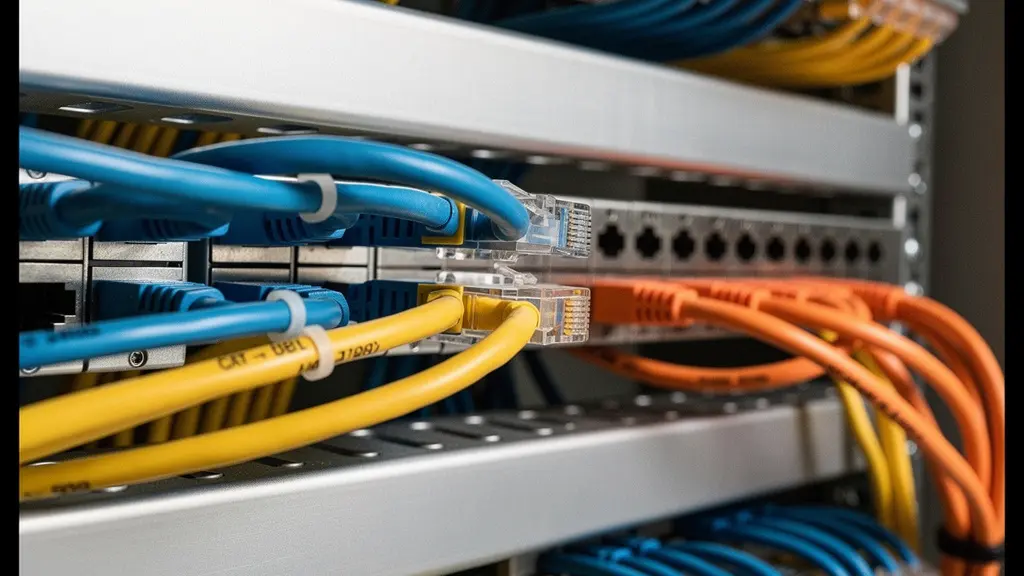
As this setup demonstrates, thinking about cable management, power requirements, and upgrade paths at the blueprint stage is what separates an amateur ‘smart home’ from a professional, high-value asset. Investing in deep electrical boxes at switch locations to accommodate the bulkier electronics of smart switches is another small detail that makes a world of difference for long-term serviceability. These are the infrastructure decisions that deliver lasting value long after the initial gadgets have become obsolete.
Smart Locks and Thermostats: Are they the new granite countertops for buyers?
Yes, but with a crucial difference: unlike a passive slab of granite, smart devices offer active, ongoing financial benefits that you can—and should—leverage in your marketing. While the novelty of a smart lock or thermostat has faded, their status as a baseline expectation for any new premium property has solidified. Buyers in markets like Toronto and Vancouver now see these devices not as a luxury, but as a standard feature. The strategic play for developers is to stop marketing the *what* (a smart lock) and start marketing the *why* (what this device does for the owner’s wallet).
The most direct benefit is energy savings. A smart thermostat, for example, is no longer just a convenience. It’s an energy management tool that can deliver tangible returns. While savings vary, they represent a recurring annual benefit you can quantify for potential buyers. However, an even more powerful and often overlooked financial incentive is the impact on home insurance premiums. This is where the value proposition becomes undeniable.
Smart security features, particularly smart locks and water leak sensors, are viewed very favourably by insurers because they actively mitigate risk. A smart lock can log every entry and exit, preventing unauthorized access, while a smart water sensor can prevent a multi-million dollar catastrophic flood. Recognizing this, major Canadian insurance providers are offering significant discounts.
Case Study: The Insurance Discount Tipping Point
Leading Canadian insurers like Intact, TD Insurance, and Aviva now offer home insurance premium discounts from 5-15% for properties with certified smart security systems. A recent analysis featured on Houseful.ca highlighted a Toronto condo development that made smart locks and water sensors a standard feature. They found that buyers saved an average of $240 annually on their insurance premiums. This recurring saving became a primary selling point, transforming a simple tech feature into a compelling financial argument for choosing their property over a competitor’s.
Who pays when the smart fridge software becomes obsolete after 5 years?
The question of software obsolescence is the ticking time bomb of the smart home industry, and developers are on the front lines. When you sell a unit with an integrated smart appliance, are you also selling a promise that its ‘smart’ features will work for the reasonable lifespan of the product? If a smart fridge’s screen stops receiving updates after five years, turning it into a “dumb” fridge with a useless tablet glued to the front, who is responsible? This is a massive area of potential liability.
Proactive developers must build a strategy to protect both themselves and their buyers. The first line of defense is procurement. Instead of chasing the flashiest proprietary system, prioritize appliances that support open standards like Matter. This “Works with…” certification ensures a baseline of interoperability and a longer functional life, even if the original manufacturer’s app disappears. Furthermore, you should negotiate extended software support agreements (minimum 7 years) with manufacturers as part of any bulk purchase agreement. This contractual obligation shifts the long-term support burden from you to the manufacturer.
Transparency with the buyer is paramount. Your purchase agreement should clearly document the expected software support lifecycle for all smart appliances. This manages expectations from the outset. Creating a separate “Smart Home Technology Warranty,” distinct from structural warranties like Ontario’s Tarion, can further clarify what is and isn’t covered. For a developer, the legal landscape is also a critical consideration, and it varies by province.
Quebec’s Consumer Protection Act provides some of the strongest protections in North America for integrated smart appliances, treating software as an essential component that must remain functional for the reasonable lifespan of the product.
– Office de la protection du consommateur, Quebec Consumer Protection Guidelines 2024
This legal precedent, especially in Quebec, underscores the importance of a long-term strategy. Ignoring software obsolescence is no longer an option; it’s a direct financial and legal risk.
Which devices consume power even when turned off (and how to stop them)?
In an era of rising energy costs and environmental awareness, marketing a development as “smart” while ignoring energy waste is a major contradiction. Many smart—and conventional—electronic devices are silent energy vampires, drawing power 24/7 even when they appear to be off. This “phantom power” can be a significant and unnecessary expense for homeowners. Educating buyers on this issue and providing built-in solutions is a powerful way to add tangible value and reinforce a brand image of true, holistic intelligence.
The culprits are often the very devices central to a modern home’s entertainment and connectivity. Cable and satellite boxes from major Canadian providers are notorious offenders, continuously drawing power to be ready for an instant-on command. Gaming consoles, smart TVs with voice activation, and even desktop computers in sleep mode are all significant contributors to this invisible energy drain. Cumulatively, this waste is substantial; according to energy-saving data, vampire power costs Canadian households between $75-$200 annually.
The solution lies in making power management itself smart. The most effective strategy is the integration of smart plugs and smart power strips. These devices can be programmed to completely cut power to certain electronics during specific times, such as overnight or when the home is unoccupied. For example, a “Good Night” scene could automatically kill power to the entire entertainment centre, while a “Vacation” mode could shut down all non-essential electronics. Key offenders in Canadian homes include:
- Cable/Satellite Boxes: Devices from Bell, Rogers, and Shaw can draw 35-45W continuously, even when ‘off’.
- Gaming Consoles: PlayStation and Xbox consoles consume 10-15W in standby mode to enable instant-on features.
- Smart TVs: Always-on features for voice activation and background updates can use 15-20W.
- Desktop Computers: A computer and monitor in sleep mode can draw 5-10W each, a figure that doubles for common dual-monitor setups.
- Kitchen Appliances: Every device with a digital clock or display, like a microwave or coffee maker, adds 3-5W to the constant load.

By pre-wiring with smart outlets in key areas or providing a starter kit of smart plugs, a developer can offer a built-in solution to a problem many homeowners don’t even know they have. It’s a low-cost, high-impact feature that demonstrates a deeper level of thought and delivers real, measurable savings.
The “C-Wire” Problem: How to install a smart thermostat without a common wire?
For a developer, the answer to this question should be simple: you don’t. You avoid the problem entirely by ensuring a C-wire is run to every thermostat location during construction. The “Common Wire” or C-wire provides continuous, reliable 24V power from the furnace to the smart thermostat. Without it, thermostats must “steal” power from the heating and cooling circuits, a workaround that is unreliable, voids many furnace warranties, and can be dangerously prone to failure, especially during Canada’s extreme weather.
Relying on the power-stealing adapters and kits that are marketed to consumers for DIY installations is a massive strategic error for a new build. These adapters are a patch for old homes, not a solution for new ones. They introduce a point of failure directly into the home’s most critical system: the HVAC. As HVAC professionals will attest, skipping this simple, inexpensive wire during construction is a sign of a poorly planned “smart” home.
Not including a C-wire in new construction is like building a garage without electrical outlets – it’s a fundamental infrastructure failure that undermines any claim of being ‘smart home ready’.
– Mike Harrison, HVAC Technician, Canadian HVAC Contractors Association Survey 2024
The potential consequences of this oversight are not merely inconvenient; they are catastrophic and legally perilous. When a Canadian winter pushes temperatures to extremes, the furnace needs maximum, stable power. Power-stealing adapters are the first thing to fail under this strain, leaving residents without heat when they need it most.
Case Study: The Alberta Cold Snap Lawsuit
A report on the February 2024 cold snap in Alberta highlighted a dramatic situation where temperatures plunged to -35°C. Service calls for smart thermostat failures skyrocketed by 340% in homes using power-stealing adapters instead of a dedicated C-wire. The adapters failed under the extreme load, cutting power to the thermostats and shutting down furnaces. One Calgary developer faced a class-action lawsuit after 47 units in their new ‘smart-ready’ development lost heating. The final settlement cost exceeded $1.2 million—a devastating sum compared to the estimated $15,000 it would have cost to properly install C-wires across the entire project during construction.
Key Takeaways
- Infrastructure Over Gadgets: The true value of a smart home lies in its bones. Prioritize future-proof infrastructure like conduit, C-wires, and centralized tech closets over specific, fast-depreciating devices.
- Plan for Liability, Not Just Features: Implement a formal digital handover protocol and understand software lifecycle costs from the outset. This transforms a potential legal nightmare into a professional, trustworthy process.
- Market the Financial Benefits: Frame smart technology not as a gimmick, but as a direct financial benefit. Highlight quantifiable savings on home insurance and energy bills to create a powerful and compelling value proposition for buyers.
Can Smart Lighting Actually Cure Your “February Blues” in Canada?
While “cure” is a strong word, the answer is leaning increasingly towards yes. Smart lighting, specifically tunable “human-centric” lighting systems, can have a profound and scientifically-backed impact on wellbeing, especially during the long, dark Canadian winters. This technology moves beyond simple dimming and color changes; it’s about actively managing the color temperature and intensity of light throughout the day to mimic the natural cycle of the sun. For developers, this feature represents a powerful and unique selling proposition that taps directly into the growing consumer focus on health and wellness.
The “February Blues,” or Seasonal Affective Disorder (SAD), is a significant issue in Canada. According to Canadian mental health data, as many as 15% of Canadians experience some form of seasonal depression, with the lack of natural light being a primary trigger. Human-centric lighting directly addresses this. By automatically shifting from a cool, energizing blue-white light (around 6500K) during the day to a warm, relaxing amber glow (around 2700K) in the evening, these systems help regulate the body’s natural circadian rhythms. This can lead to improved mood, better sleep, and increased daytime alertness.
Marketing a property with a built-in solution to a widespread Canadian problem is a brilliant strategic move. It elevates the conversation from smart tech as a convenience to smart tech as a core component of a healthy living environment. The results from developments that have pioneered this approach speak for themselves.
Case Study: Edmonton’s ‘Bring the Sun Inside’ Success
A luxury condominium development in Edmonton, a city known for its long winters, integrated tunable white LED systems with automated circadian rhythm programming as a standard feature. They marketed the system under the compelling banner, “Bring the Sun Inside.” The results were remarkable: the development saw 23% faster sales compared to similar, non-equipped units in the area. More importantly, post-occupancy surveys revealed that 67% of residents reported a noticeable improvement in their mood and energy levels during the winter months, ranking the feature as their second most-valued amenity, just after in-suite laundry.
For developers ready to move beyond amenities and build true digital equity, the next step is to audit your current and future projects against these strategic benchmarks. Begin by evaluating your wiring plans, procurement strategies, and handover protocols to transform your properties from simply being ‘smart-equipped’ to becoming genuine ‘smart-investments’ that command a premium in any market condition.