
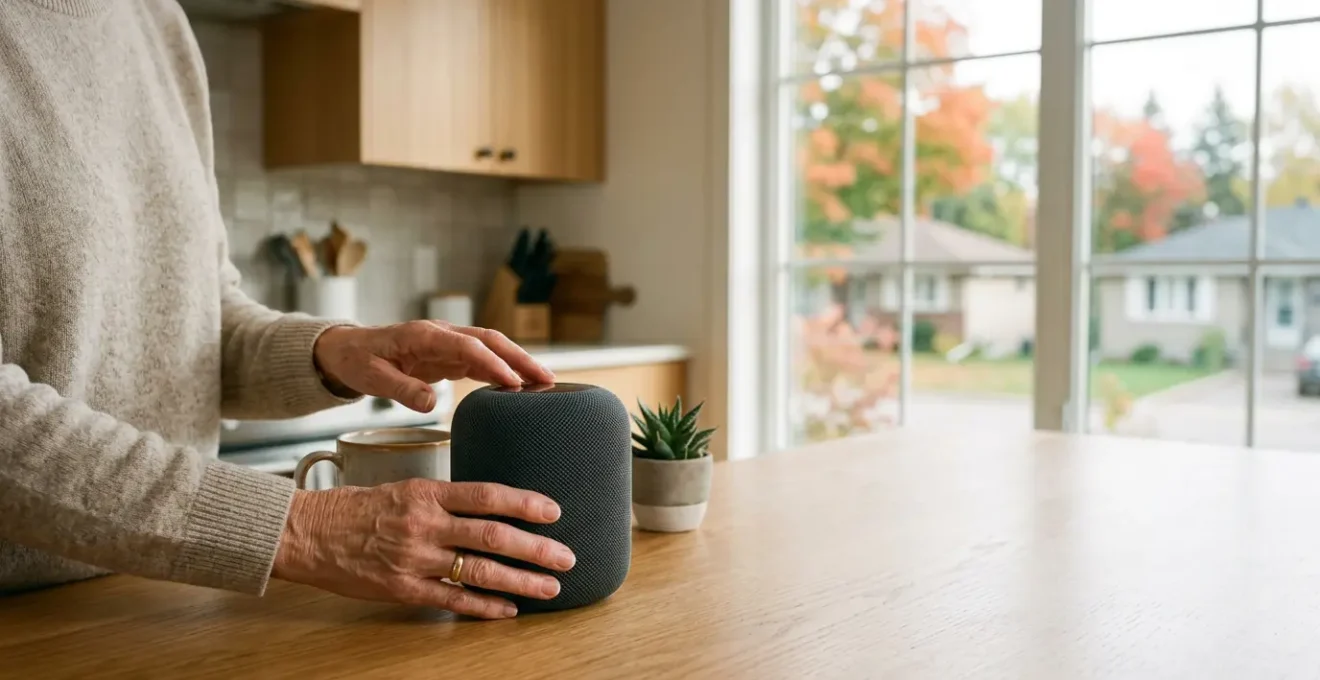
The greatest challenge for adult children is balancing a parent’s fierce desire for independence with genuine concerns about their safety and well-being at home.
- Voice-controlled devices can overcome physical limitations like arthritis or vision loss, restoring control over the home environment.
- Smart displays and privacy-respecting sensors directly combat two major threats to aging in place: social isolation and the risk of falls.
Recommendation: Instead of buying a collection of gadgets, focus on identifying one or two specific daily challenges your parent faces and deploy a targeted technology to solve it.
For many Canadian families, the conversation around aging is one of the most difficult. Your parents value their independence and the comfort of the home they’ve built over decades. You, on the other hand, may worry about their safety, their health, and the growing risk of social isolation. It’s a delicate balance between respecting their autonomy and ensuring their well-being. Often, the discussion defaults to traditional solutions like personal emergency response pendants or discussions about downsizing, options that can feel reactive and even disempowering for a senior.
But what if the solution wasn’t about preparing for the worst-case scenario, but about proactively improving daily life? The key lies not in simply buying gadgets, but in a strategic approach. Effective aging-in-place technology is about deploying specific tools to solve the precise, daily challenges that threaten a senior’s autonomy and quality of life. It’s about creating an environmental support system that adapts to their needs, rather than asking them to adapt to new limitations. From the physical frustration of arthritis to the cognitive load of managing multiple medications, a well-designed smart home can provide discreet, powerful assistance.
This article moves beyond a simple product list. We will explore how specific technologies address core challenges faced by aging Canadians. We’ll look at the “why” behind each device, connecting its features to tangible improvements in safety, connection, and dignity, allowing you to build a thoughtful strategy tailored to your parent’s unique situation.
To help you navigate these solutions, this guide breaks down the most impactful technologies by the specific problems they solve. You will find practical insights and targeted advice to make informed decisions for your family.
Summary: A Strategic Guide to Smart Home Technology for Aging in Place
- Smart Speakers: Why voice commands are a game-changer for seniors with arthritis?
- Smart Displays: The easiest way for grandparents to video call without tech support?
- Smart Pill Dispensers: Preventing dosage errors with connected alerts?
- Radar Sensors: Detecting falls without compromising privacy with video cameras?
- Smart Doorbells: How to let seniors see who is at the door without getting up?
- Cold Bedrooms: How remote sensors balance temperature in multi-story homes?
- Trigger Actions: How to turn on a radio automatically when someone approaches your porch?
- Personal Safety Wearables: Tech Solutions for Lone Workers and Solo Travelers?
Smart Speakers: Why voice commands are a game-changer for seniors with arthritis?
For a senior experiencing arthritis, rheumatism, or declining dexterity, the modern world can feel full of tiny, frustrating barriers. Operating a small smartphone screen, pressing fiddly buttons on a remote control, or even turning a stiff dial can become a daily struggle. This is where voice-controlled smart speakers (like Google Nest or Amazon Echo) transition from a novelty to a profound accessibility tool. They offer a method of frictionless interaction with the home environment, removing the physical barrier to control and information.
The utility extends far beyond just playing music. A senior can control lights, adjust the thermostat, set reminders for appointments, or ask for the weather forecast without moving from their chair or fumbling with a device. This is particularly crucial for those with mobility challenges or visual impairments. For the estimated 1.5 million Canadians who have sight loss, voice commands provide an essential link to information and home control. Simple requests like “What time is it?” or “Call my daughter” restore a sense of immediate capability.
This technology also serves as a tool for cognitive offloading. Instead of having to remember a sequence of button presses, the user only needs to recall a simple, natural language command. As Dr. Frank Knoefel, a physician at the Bruyère Memory Program, states, this is about enabling a core human desire. “People want to stay at home and remain independent for as long as they can, and this technology can help.” By reducing physical and cognitive friction, smart speakers empower seniors to manage their surroundings with ease and dignity.
Smart Displays: The easiest way for grandparents to video call without tech support?
While smart speakers excel at audio-based tasks, the addition of a screen transforms the device into a powerful portal for human connection. Smart displays (like the Google Nest Hub or Amazon Echo Show) address one of the most pervasive and damaging aspects of aging: social isolation. For a grandparent who may not be comfortable with computers or smartphones, these devices offer the simplest possible interface for video calling. A command like, “Hey Google, call Sarah,” can instantly initiate a face-to-face conversation with a grandchild, without navigating menus or apps.
The importance of this cannot be overstated in a Canadian context. A National Institute on Ageing report reveals that 58% of Canadians aged 50 and over have experienced loneliness. This isolation has been linked to cognitive decline, depression, and other negative health outcomes. A smart display acts as a constant, ambient connection point. It can cycle through family photos like a digital picture frame, making the home feel more populated and loved, and then seamlessly switch to a live video call, bridging the physical distance between family members.
This technology provides a means of frictionless connection. It eliminates the need for tech support from family members, a common point of frustration for both seniors and their children. The intuitive, voice-first operation allows grandparents to initiate contact on their own terms, preserving their sense of agency and encouraging more frequent, spontaneous interactions that are vital for mental and emotional well-being. It is a direct, effective tool against the quiet epidemic of senior loneliness.
Smart Pill Dispensers: Preventing dosage errors with connected alerts?
Medication management is one of the most critical and anxiety-inducing tasks for seniors and their caregivers. A complex regimen involving multiple pills at different times of day can be confusing, and a missed or incorrect dose can have serious health consequences. Smart pill dispensers are a form of proactive autonomy technology, designed to offload this cognitive burden and introduce a reliable system of checks and balances. These devices go far beyond a simple pillbox with alarms.
A smart dispenser, like Hero or Loba, typically holds a multi-day supply of medication. At pre-programmed times, it dispenses the correct pills and provides an audible and visual alert. Its most important feature, however, is its connectivity. If a dose is missed, the device can send an automated notification—a text message or app alert—to a designated family member or caregiver. This creates a safety net, allowing for a quick phone call to remind the parent to take their medication, transforming a potential medical issue into a simple, timely intervention.
This system provides peace of mind for adult children who may not be able to check in physically every day. It provides a log of when medications were dispensed and taken, offering valuable data that can be shared with physicians to track adherence and health outcomes. For the senior, it removes the constant worry of remembering complex schedules, allowing them to feel more confident and in control of their own health management. To implement such a system effectively in Canada, a few key steps can ensure seamless integration with local healthcare providers.
Your Action Plan: Integrating a Smart Dispenser with Canadian Pharmacies
- Contact your pharmacy (e.g., Shoppers Drug Mart, Jean Coutu) to ask about blister pack medication packaging, which simplifies loading.
- Request medication synchronization so all prescriptions can be refilled on the same monthly schedule.
- Choose a dispenser with caregiver notification features that alert family members about missed doses.
- Work with your pharmacist to correctly load the dispenser, organizing medications by the exact time of day.
- Enable the alert system to notify both the senior and designated caregivers of all scheduled doses.
Radar Sensors: Detecting falls without compromising privacy with video cameras?
The fear of a fall is perhaps the single biggest concern for seniors living alone and their families. While traditional PERS pendants are effective, they rely on the senior being able and willing to press a button, and they are often only worn intermittently. Cameras offer constant monitoring but come at a significant cost to privacy and dignity. A new generation of technology offers a powerful alternative: passive radar sensors. These devices represent the pinnacle of dignified monitoring.
Unlike a camera, a wall-mounted radar sensor (from companies like Xandar Kardian or Vayyar) uses low-power radio waves to monitor a room for movement and presence. It can detect micro-movements like breathing to confirm a person is in the room and, most importantly, can identify the sudden change in position and lack of movement that indicates a fall. When a fall is detected, it can automatically trigger an alert to a caregiver or an emergency service—no button press required.
The key innovation is what it *doesn’t* capture: images. As Bruce Wallace, executive director of the SAM3 AGE-WELL National Innovation Hub, explains, “Passive sensing is one of the keys to success. It means people won’t need to wear devices and cameras won’t capture or share images.” This respect for privacy is crucial for adoption. It allows for continuous, reliable fall detection in high-risk areas like the bathroom or bedroom, where a senior is least likely to be wearing a pendant and where cameras are most intrusive. It provides a robust safety net without making a parent feel like their personal space is under constant surveillance.
Smart Doorbells: How to let seniors see who is at the door without getting up?
The simple act of answering the front door can be a source of both physical risk and security anxiety for an older adult. Rushing to the door can increase the risk of a fall, while opening it to an unknown person can be a security concern. Smart video doorbells (from brands like Ring or Google Nest) directly address both issues by giving a senior the ability to see and speak to visitors from anywhere in the home, using a smartphone or a smart display.
When a visitor presses the button or when motion is detected, an alert is sent. The senior can view a live video feed and engage in a two-way conversation without needing to get up. This is not just a convenience; it’s a critical security tool. It allows them to verify a delivery person’s identity, ask a salesperson to leave, or tell a friend they’ll be a moment, all while remaining safely seated. This is especially relevant given that seniors are often targets for fraud. Data from the Canadian Anti-Fraud Centre shows that in 2022, seniors lost 33% more to fraud than other age groups, with door-to-door scams being a common tactic.
Shared access can also be given to a trusted adult child, who can receive alerts and help screen visitors remotely, adding another layer of security. In the harsh Canadian winter, it also means a senior doesn’t have to open the door to a blast of cold air just to see who is there. A smart doorbell empowers a senior by giving them complete control over their home’s primary entry point, enhancing both their physical safety and their security.
Cold Bedrooms: How remote sensors balance temperature in multi-story homes?
Maintaining a comfortable and healthy home environment goes beyond single-task solutions. It requires a holistic view of the living space, and temperature is a critical, often overlooked, component. In many multi-story Canadian homes, heat distribution is uneven, leading to a main floor that is comfortable while upstairs bedrooms become too cold, especially at night. For a senior, this isn’t just a matter of comfort; it can impact sleep quality and health. A cold room can aggravate arthritis and increase the risk of illness.
This is a problem that a smart thermostat alone cannot solve, as it only measures the temperature in one location (usually a central hallway). The solution lies in pairing a smart thermostat with small, wireless remote temperature sensors. These sensors can be placed in any room, such as the master bedroom or a favorite reading nook. The smart thermostat can then be programmed to adjust the heating or cooling based on the temperature in that specific room, rather than the hallway. For instance, it can be set to “prioritize the bedroom temperature between 10 PM and 7 AM” to ensure a comfortable sleeping environment.
This creates an adaptive environmental support system that actively manages comfort and health. It’s a subtle but powerful application of smart technology. Given that the Public Health Agency of Canada reports that over 9 in 10 Canadians aged 65 and over live in private homes, optimizing these personal environments is paramount. Ensuring thermal comfort is a foundational element of making a home truly safe and livable for the long term, reducing health risks associated with being too cold and improving overall quality of life.
Trigger Actions: How to turn on a radio automatically when someone approaches your porch?
The true power of a smart home is realized when individual devices begin to work together. This is accomplished through “routines” or “trigger actions”—simple automations that cause one device’s action to trigger a response from another. This is where you can build a truly intelligent and responsive environmental support system tailored to your parent’s daily life and security needs. It transforms a collection of gadgets into a cohesive, helpful ecosystem.
For example, a motion sensor on the front porch can be linked to more than just a security light. You can create a routine where, if motion is detected after dark, not only does the porch light turn on, but an indoor radio also turns on to a news station. This “simulated occupancy” is a powerful deterrent to potential intruders, giving the impression that someone is awake and alert inside. This moves beyond simple security to a proactive defense strategy.
The applications for safety and well-being are vast. Consider these practical automation routines:
- Nighttime Pathway: A motion sensor in the hallway can trigger the hall lights to turn on to a dim 30% brightness, preventing falls during late-night trips to the bathroom.
- Morning Routine: At 7 AM, lights can be programmed to slowly brighten while a smart speaker begins playing CBC Radio One, providing gentle waking cues and establishing daily structure.
- Safety Alerts: A smart smoke detector can be linked to all the smart lights in the house, causing them to flash red during an alarm, providing a crucial visual cue for someone who is hard of hearing.
These routines require a bit of initial setup but then operate automatically in the background, providing constant, unobtrusive support. They reduce cognitive load and automate safety, helping a senior navigate their home more confidently and securely at all hours.
Key Takeaways
- True aging-in-place success comes from matching specific technology to a specific daily problem, not from simply accumulating devices.
- The best solutions enhance autonomy and dignity by being passive and privacy-preserving, like radar fall detectors over indoor cameras.
- Integrating devices through automated routines (e.g., motion sensors triggering lights and radio) creates a supportive environment that enhances safety and security.
Personal Safety Wearables: Tech Solutions for Lone Workers and Solo Travelers?
While the focus of this guide is on creating a supportive home environment, it’s crucial to compare this approach with wearable technology, the more traditional solution for senior safety. Personal Emergency Response Systems (PERS) have been a lifeline for decades, but modern smartwatches now offer competing features. For a Canadian adult child, understanding the trade-offs is key to making the right choice.
Traditional PERS devices, from providers like Philips Lifeline or TELUS LivingWell in Canada, offer one primary, expertly executed service: 24/7 access to a live monitoring agent. This is their core strength. Modern smartwatches, like the Apple Watch, integrate fall detection and emergency SOS calls to 911 but lack this dedicated human oversight. However, they offer a wealth of other health monitoring features—from ECG to activity tracking—and carry far less social stigma. The decision often comes down to a choice between a specialized safety service and a multi-functional lifestyle device.
The following table provides a clear comparison based on factors relevant to Canadian consumers.
| Feature | Traditional PERS (Philips Lifeline, TELUS LivingWell) | Modern Wearables (Apple Watch, Smartwatches) |
|---|---|---|
| Monthly Fee | $40-60 CAD/month for monitoring service | No monthly fee (cellular plan optional) |
| Fall Detection | Manual button press or automatic pendant sensors | Built-in accelerometer with automatic detection |
| Two-Way Communication | Yes, with live operator 24/7 | Limited (emergency SOS calls 911, no live operator) |
| GPS Tracking | Available in premium models ($60+/month) | Standard in most cellular models |
| Coverage Area | Canada-wide cellular networks | Varies by carrier; rural coverage can be limited |
| Battery Life | Several days to weeks | 18-36 hours (daily charging required) |
| Device Cost | Often included with monthly service | $329-529 CAD upfront |
| Social Stigma | Higher (visible pendant design) | Lower (modern, discreet smartwatch) |
| Health Monitoring | Fall detection only | Heart rate, ECG, oxygen levels, activity tracking |
Ultimately, the best choice depends on the individual. For a senior who is primarily concerned with at-home falls and wants the reassurance of a human operator, a traditional PERS may be superior. For a more active, tech-savvy senior who values discretion and additional health metrics, a smartwatch may offer greater proactive autonomy. Both are valid tools in a comprehensive safety plan.
The ultimate goal is not to fill a home with technology, but to use it thoughtfully to extend independence, enhance safety, and preserve quality of life. By starting with the specific challenges your parent faces, you can build a supportive, dignified, and effective aging-in-place strategy that brings peace of mind to your entire family.